F. Financial Literacy · Money and Finances: Moving Money, Sales Tax, Budgets, Credit and Best ValueTotals and Change with Dollars and Cents
F1.2 A1About 40 minutes
Learning goals- I can estimate the total cost of several items priced in dollars and cents.
- I can add prices in dollars and cents, using mental math or by lining up the decimal points.
- I can find the change by counting up.
- I can round a cash total to the nearest 5 cents, because Canada no longer uses pennies.
Words to know
total
The amount you pay for everything together.
change
The money you get back when you pay more than the total.
estimate
A close guess you work out with friendly numbers.
compensation
A mental math trick: change a price to a friendly number, then fix the answer. $2.99 is $3.00 minus 1¢.
decimal point
The dot that separates dollars from cents: $12.45 is 12 dollars and 45 cents.
Remember from Grade 4
In Grade 4 you found totals and change for prices in whole dollars, like $14 + $18. In Grade 5, prices have dollars and cents, like $4.25. You will use the same smart ideas: estimate first, calculate, then check.
Welcome to the winter craft fair!
Your school is holding a winter craft fair. The prices are written on little cards. At this fair, no tax is added (you will learn about sales tax in the next lesson).
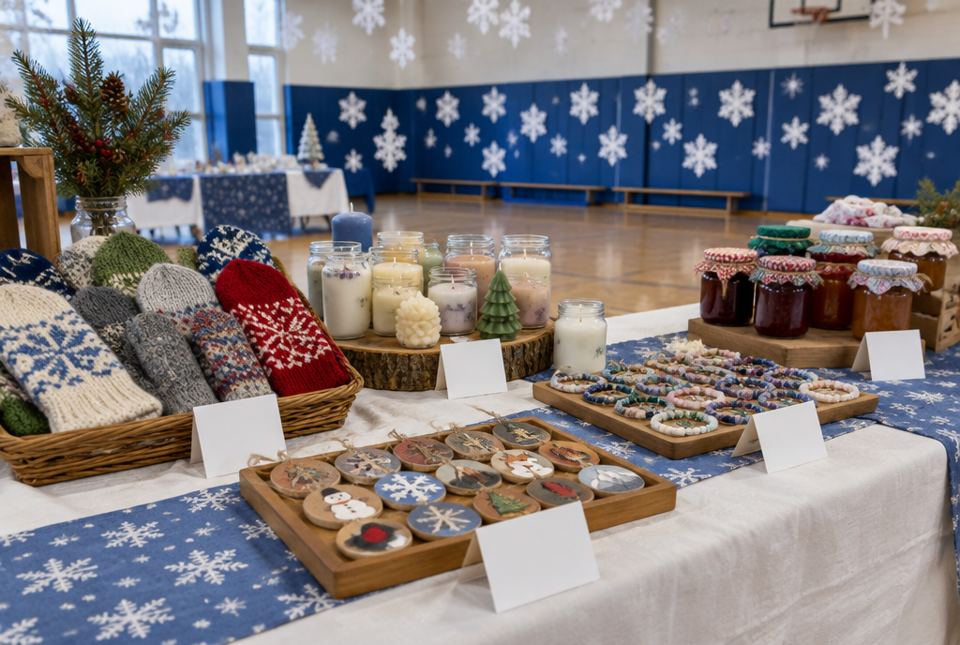 Handmade crafts at a winter craft fair. Each little card would show a price in dollars and cents. AI-generated image
| Item | Price |
|---|
| Bead bracelet | $2.75 |
| Bag of maple cookies | $1.60 |
| Knitted toque | $8.75 |
| Candle | $4.25 |
| Bird feeder | $6.40 |
| Painted rock | $0.95 |
| Hot chocolate | $1.35 |
Reading money amounts
$4.25 means 4 dollars and 25 cents. The decimal point separates the dollars from the cents. 100 cents make 1 dollar, so 25 cents is 25 hundredths of a dollar.
Strategy 1: Estimate first
Round each price to the nearest dollar. Look at the cents: 50¢ or more, round up. Less than 50¢, round down.
- $8.75 → $9
- $4.25 → $4
- $1.60 → $2
Estimate: $9 + $4 + $2 = about $15.
Strategy 2: Friendly numbers (compensation)
Prices like $0.95 or $4.99 are close to a whole dollar. Use the whole dollar, then fix the answer.
$0.95 is $1.00 minus 5¢. So $6.40 + $0.95 = $6.40 + $1.00 − 5¢ = $7.40 − 5¢ = $7.35.
Strategy 3: Dollars, then cents
Add the dollars, add the cents, then put them together.
$2.75 + $1.35: dollars 2 + 1 = 3. Cents 75 + 35 = 110 cents = $1.10. Total $4.10.
Strategy 4: Line up the decimal points
For three or more prices, write them in a column with the decimal points lined up, then add like whole numbers, regrouping as needed.
Worked exampleExample 1: Three items in a column
Owen buys a knitted toque ($8.75), a candle ($4.25) and a bag of maple cookies ($1.60). What is the total?
- Estimate: $9 + $4 + $2 = about $15.
- Line up the decimal points:
8.75
4.25
+ 1.60 - Hundredths: 5 + 5 + 0 = 10. Write 0, regroup 1 tenth.
- Tenths: 1 + 7 + 2 + 6 = 16. Write 6, regroup 1 dollar.
- Ones: 1 + 8 + 4 + 1 = 14.
- Total: $14.60. Check: $14.60 is close to the estimate of $15.
Worked exampleExample 2: Count up to find the change
Owen pays for his $14.60 total with a $20 bill. How much change should he get?
- Count up from the total to the money paid, using friendly stops.
- $14.60 → $15.00 is $0.40.
- $15.00 → $20.00 is $5.00.
- Add the jumps: $0.40 + $5.00 = $5.40.
- Check: $14.60 + $5.40 = $20.00. ✔
Owen's change is $5.40 (a $5 bill, a quarter, a dime and a nickel).
Counting up from $14.60 to $20.00 (not to scale).No more pennies: rounding cash totals
Canada no longer uses pennies. When you pay with cash, the total is rounded to the nearest 5 cents. When you pay with a card, you pay the exact amount.
Look at the last digit of the cents:
- 1 or 2: round down to 0. ($3.62 → $3.60)
- 3 or 4: round up to 5. ($5.04 → $5.05)
- 6 or 7: round down to 5. ($2.47 → $2.45)
- 8 or 9: round up to the next 10 cents. ($9.98 → $10.00)
- 0 or 5: no change.
Worked exampleExample 3: Cash or card?
At the corner store, Jada's total is $7.48. How much does she pay with cash? How much with a debit card? If she pays cash with a $10 bill, what is her change?
- Cash: the last digit is 8, so round up to $7.50.
- Debit card: she pays the exact amount, $7.48.
- Change from $10 for a $7.50 cash total: $7.50 → $8.00 is $0.50, and $8.00 → $10.00 is $2.00.
- $0.50 + $2.00 = $2.50.
Cash: $7.50, with $2.50 change. Debit: $7.48.
Estimate, calculate, check
- Estimate so you know about what the answer should be.
- Calculate with a strategy you choose.
- Check: total + change should equal the money you paid.
If your answer is far from your estimate, look for a mistake, like decimal points that are not lined up.
Keep going
Long money problems can feel like a lot. Break them into small steps and write each one down. Making a mistake and fixing it is how your brain gets stronger.
Just for funFunny but true: Canada's Mint stopped making pennies in 2012. Many of them are still enjoying their retirement in jars on kitchen counters across the country!
Hands-on activityRun your own craft fair
You need: coins and bills (real or play money, or paper slips with amounts written on them), sticky notes and 5 to 8 things from home to "sell".
- Put a price in dollars and cents on each item with a sticky note (for example, $1.35 or $3.80). Keep prices under $10.
- Take turns being the shopper and the cashier.
- The shopper picks 2 or 3 items and estimates the total out loud.
- The cashier calculates the exact total on paper. If paying cash, the cashier rounds to the nearest 5 cents.
- The shopper pays with a bigger bill. The cashier counts up the change.
- Both check: total + change = money paid.
What to look for: estimates within about a dollar or two of the exact total, decimal points lined up, and change that adds back to the money paid.
Your turn
1Find the cost of a bead bracelet ($2.75) and a hot chocolate ($1.35).
$4.10. Dollars: 2 + 1 = 3. Cents: 75 + 35 = 110 cents = $1.10. $3 + $1.10 = $4.10.
2Find the cost of a bird feeder ($6.40) and a candle ($4.25).
$10.65. Dollars: 6 + 4 = 10. Cents: 40 + 25 = 65.
3Estimate, then find the exact cost of a toque ($8.75), a bird feeder ($6.40) and a bracelet ($2.75).
Estimate: $9 + $6 + $3 = about $18. Exact: $8.75 + $6.40 = $15.15, then $15.15 + $2.75 = $17.90.
4You buy a candle ($4.25) with a $10 bill. What is your change?
$5.75. $4.25 → $5.00 is $0.75, $5.00 → $10.00 is $5.00. $0.75 + $5.00 = $5.75.
5You buy two bags of maple cookies ($1.60 each) and a toque ($8.75). You pay with a $20 bill. What is your change?
Total: $1.60 + $1.60 = $3.20, then $3.20 + $8.75 = $11.95. Change: $11.95 → $12.00 is $0.05, $12.00 → $20.00 is $8.00. Change = $8.05.
6Round each cash total to the nearest 5 cents: $3.62, $9.98, $5.04.
$3.60 (2 rounds down), $10.00 (8 rounds up), $5.05 (4 rounds up to 5).
7Is $15 enough for a bird feeder ($6.40), a candle ($4.25) and a bracelet ($2.75)?
Yes. $6.40 + $4.25 = $10.65, then $10.65 + $2.75 = $13.40. There is $1.60 left over.
More practice: warm-up
$2.30. $1.00 + $1.35 = $2.35, then take away 5¢.
$3.40. Count up: $1.60 → $2.00 is $0.40, $2.00 → $5.00 is $3.00.
3Round $4.75 to the nearest dollar.
$5. 75 cents is more than 50 cents, so round up.
4How much do 3 hot chocolates at $1.35 each cost?
$4.05. $1.35 + $1.35 = $2.70, then + $1.35 = $4.05.
$3.60. $6.40 → $7.00 is $0.60, $7.00 → $10.00 is $3.00.
More practice: on your own
1Find the cost of 3 hot chocolates ($1.35 each) and 2 painted rocks ($0.95 each).
$5.95. 3 × $1.35 = $4.05. 2 × $0.95 = $1.90 (that's $2.00 − 10¢). $4.05 + $1.90 = $5.95.
2Maya has $25. She buys a toque ($8.75) and two candles ($4.25 each). How much does she have left? Can she also buy a bird feeder ($6.40)?
Two candles: $8.50. Toque + candles: $8.75 + $8.50 = $17.25. Left: $25.00 − $17.25 = $7.75. Yes, she can buy the bird feeder: $7.75 − $6.40 = $1.35 left, just enough for a hot chocolate!
3Leo says a bird feeder ($6.40), a toque ($8.75) and a candle ($4.25) cost about $30. Is his estimate reasonable?
No. $6 + $9 + $4 = about $19, not $30. Exact: $6.40 + $8.75 = $15.15, then + $4.25 = $19.40.
4A cash total is $12.37. How much do you pay in cash? What is your change from a $20 bill?
Round $12.37 to $12.35 (7 rounds down to 5). Change: $12.35 → $13.00 is $0.65, $13.00 → $20.00 is $7.00. Change = $7.65.
5Ava bought a candle ($4.25) and one other item. She paid with a $10 bill and got $3.00 change. Which other item did she buy?
She spent $10.00 − $3.00 = $7.00. $7.00 − $4.25 = $2.75, so she bought a bead bracelet.
Challenge
1You have $10 at the craft fair. What is the greatest number of different items you can buy? Show one way.
4 items. The five cheapest items cost $0.95 + $1.35 + $1.60 + $2.75 + $4.25 = $10.90, which is more than $10, so 5 items is impossible. One way with 4: painted rock, hot chocolate, maple cookies and bead bracelet: $0.95 + $1.35 + $1.60 + $2.75 = $6.65. (Another: bracelet, cookies, candle and hot chocolate = $9.95.)
2Ben's total is $13.93. He pays cash with a $20 bill. What is his change? His friend buys the same things with a debit card. Who pays more, and by how much?
Cash: $13.93 rounds to $13.95 (3 rounds up to 5). Change: $13.95 → $14.00 is $0.05, $14.00 → $20.00 is $6.00, so $6.05. The friend pays exactly $13.93, so Ben pays 2¢ more.
3A class buys 24 hot chocolates at $1.35 each for a skating trip. The teacher pays with two $20 bills. What is the change?
Total: 24 × $1.35. 24 × $1 = $24.00 and 24 × $0.35 = $8.40 (24 × 35¢ = 840¢). $24.00 + $8.40 = $32.40. Change: $40.00 − $32.40 = $7.60.
Quiz
2. You pay for $6.35 with a $10 bill. What is your change?
3. Paying with cash, a total of $8.22 becomes:
4. Paying with cash, a total of $4.98 becomes:
5. What is the best estimate for $5.89 + $3.12 + $0.97?
6. Use friendly numbers: $4.99 + $2.99 = ?
What your child is learning: the Ontario curriculum (F1.2) asks Grade 5 students to estimate and calculate the cost of transactions involving multiple items priced in dollars and cents, including sales tax, using various strategies. This lesson covers dollars and cents; the next lesson adds sales tax. In Grade 4 prices were in whole dollars. Choosing a strategy and checking reasonableness are mathematical processes (A1).
Common difficulties:
- Not lining up decimal points, for example adding $8.75 and $1.6 as if the 6 were hundredths. Encourage writing $1.60 with two decimal places.
- Forgetting to regroup 100 cents into a dollar (75¢ + 35¢ = 110¢ = $1.10).
- Cash rounding: only cash totals are rounded to the nearest 5¢; card payments are exact. Rounding happens to the total, not each item.
How to help: At a store or with a flyer, ask your child to estimate the total of three items, then check against the receipt (remember, the receipt will include tax on most non-food items). When paying cash, let your child predict the change before the cashier hands it over.