D. Data · Data and ProbabilityMean, Median and Mode with Decimal Numbers
D1.5About 50 minutes
Learning goals- I can find the mean, median and mode(s) of data sets with whole numbers and decimal numbers.
- I can write a mean as a decimal when the division has a remainder.
- I can find the median of an even number of values, even when it is a decimal.
- I can explain what each measure tells about the data, and which one best describes a typical value.
Words to know
mean
The fair share: add all the values, then divide by how many values there are.
median
The middle value when the data is in order. With an even number of values, it is halfway between the two middle values.
mode
The value that appears most often. A data set can have one mode, more than one mode, or no mode.
outlier
A value that is much bigger or much smaller than the rest of the data.
Remember from Grade 4
You found the mean (add, then divide), the median (the middle value in order) and the mode (the most common value) of whole-number data. In Grade 5 the data can be decimal numbers, like 2.4 m or $3.50, and the mean might come out as a decimal too.
Long-jump day
Five friends did the long jump at the winter track club. Their jumps, in metres:
2.4, 2.1, 2.7, 2.4, 2.9
What is a typical jump? We can answer with the median, the mode or the mean.
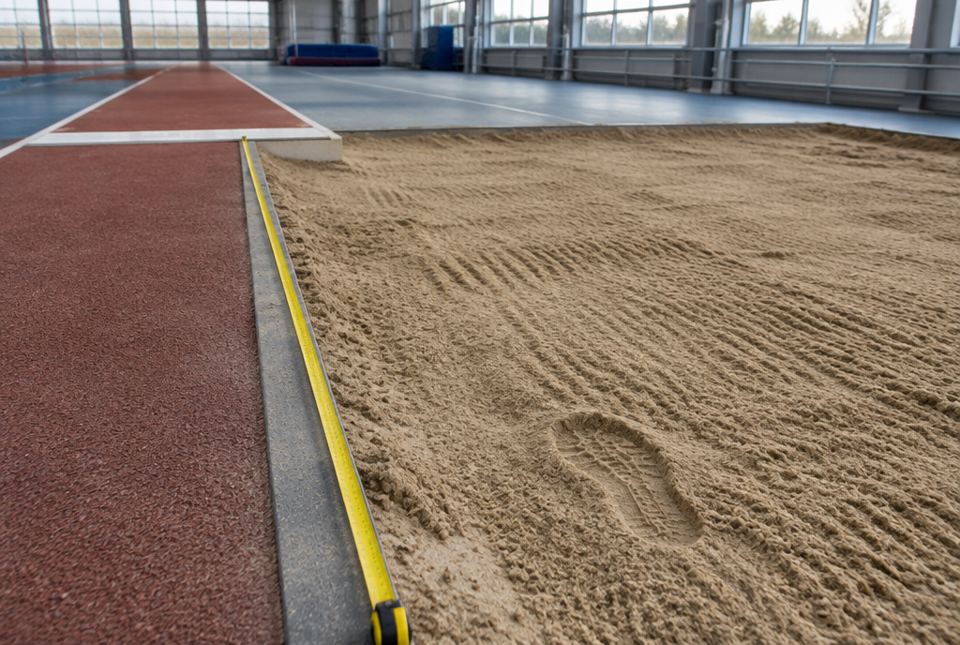 A long jump is measured from the take-off board to the mark in the sand. Jumps like 2.4 m are measured in metres to the nearest tenth. AI-generated image
Worked exampleExample 1: Mean, median and mode of decimals
Find the median, mode and mean of the jumps: 2.4, 2.1, 2.7, 2.4, 2.9 (metres).
- Order the values: 2.1, 2.4, 2.4, 2.7, 2.9.
- Median: there are 5 values, so the middle one is the 3rd: 2.4 m.
- Mode: 2.4 appears twice. The mode is 2.4 m.
- Mean: add them. 2.1 + 2.4 + 2.4 + 2.7 + 2.9 = 12.5.
- Divide by 5. Think of 12.5 as 125 tenths. 125 tenths ÷ 5 = 25 tenths = 2.5.
Median 2.4 m, mode 2.4 m, mean 2.5 m.
The five jumps on a line. The median is the middle dot and the mode is the value that appears twice, both 2.4 m. The mean, 2.5 m, is where the line would balance.When the mean is a decimal
Sometimes whole-number data has a mean that is a decimal.
Four friends read 18, 25, 32 and 40 pages. The total is 115. 115 ÷ 4 = 28 R3. The remainder 3 is 3/4 of another page, and 3/4 = 0.75. So the mean is 28.75 pages.
That's fine! A mean doesn't have to be one of the data values. It's the fair share: if they had all read the same number, each would have read 28.75 pages.
Worked exampleExample 2: An even number of values
Find the median and the mean of 18, 25, 32, 40 pages.
- The values are already in order: 18, 25, 32, 40.
- There are 4 values, so there are two middle values: 25 and 32.
- The median is halfway between 25 and 32. 25 + 32 = 57, and 57 ÷ 2 = 28.5.
- The mean is 115 ÷ 4 = 28.75 (from above).
- Mode: no value appears more than once, so there is no mode.
Median 28.5, mean 28.75, no mode.
Worked exampleExample 3: Money data
Six snacks at the school fun fair cost $1.25, $2.50, $1.75, $1.25, $3.00, $2.25. Find the mean, median and mode.
- Add: 1.25 + 2.50 + 1.75 + 1.25 + 3.00 + 2.25 = $12.00.
- Mean: $12.00 ÷ 6 = $2.00.
- Order: 1.25, 1.25, 1.75, 2.25, 2.50, 3.00. The two middle values are 1.75 and 2.25. Halfway between them is $2.00.
- Mode: $1.25 appears twice. The mode is $1.25.
Mean $2.00, median $2.00, mode $1.25.
What does each one tell us?
- Mode: the most common value. Good for questions like "Which price shows up most?"
- Median: the middle. Half the values are at or below it, and half are at or above it.
- Mean: the fair share, if everything were evened out.
Watch out for outliers
One week, the snowfall at Sam's house was 2.5, 3.0, 2.5, 3.5 and then a big storm on Friday: 23.5 cm.
- Mean: 2.5 + 3.0 + 2.5 + 3.5 + 23.5 = 35.0, and 35.0 ÷ 5 = 7.0 cm.
- Median: in order 2.5, 2.5, 3.0, 3.5, 23.5 → 3.0 cm.
- Mode: 2.5 cm.
The one big storm (an outlier) pulled the mean up to 7.0 cm, but four of the five days had less than 4 cm! The median (3.0 cm) describes a typical day better. When there is an outlier, the median is often the better choice.
Keep going!
Adding a long list of decimals takes patience. Line up the decimal points, go one step at a time, and check your total by adding in a different order. If your mean is bigger than the largest value or smaller than the smallest value, something went wrong. That's a useful clue, not a failure!
Just for funMean, median and mode go to a bakery. Mode orders whatever most people ordered. Median stands right in the middle of the line. And mean asks everyone to share the cookies so each person gets a fair share!
Hands-on activityMeasure your family's hand spans
You need: a ruler with centimetres and millimetres, paper and a pencil. A calculator is optional, for checking.
- Spread your hand wide on the table. Measure from the tip of your thumb to the tip of your little finger, to the nearest tenth of a centimetre (the nearest millimetre). Example: 17.3 cm.
- Measure the hand span of 5 or more people (or the same person's right and left hands, plus a few more people).
- Order the values. Find the median, the mode (if there is one) and the mean.
- Check your mean with a calculator if you have one.
- Talk about it: Is anyone's span an outlier? Which measure best describes a typical hand span in your family?
Your turn
1Find the median: 3.6, 2.8, 4.1, 3.2, 3.9
3.6. In order: 2.8, 3.2, 3.6, 3.9, 4.1. The middle (3rd) value is 3.6.
2Find the mode: 1.5, 2.0, 1.5, 2.5, 3.0
3Find the mean: 2.5, 3.5, 4.0, 2.0
3.0. Total: 12.0. 12.0 ÷ 4 = 3.0.
4Find the median: 5.2, 4.8, 6.0, 5.6
5.4. In order: 4.8, 5.2, 5.6, 6.0. Halfway between 5.2 and 5.6 is 5.4.
5Find the mean: 7, 8, 6, 9
7.5. Total: 30. 30 ÷ 4 = 7 R2, and 2/4 = 0.5, so 7.5.
6Find the mode: 4.1, 3.7, 5.2
No mode. No value appears more than once.
7Find the mode(s): 6, 8, 6, 9, 8, 7
6 and 8. Each appears twice. This data set has two modes.
More practice: warm-up
1Find the median: 1.2, 1.8, 1.5
1.5. In order: 1.2, 1.5, 1.8.
2Find the mode: 0.5, 0.75, 0.5, 1.0
3Find the mean of 4.5 and 5.5.
5. 4.5 + 5.5 = 10, and 10 ÷ 2 = 5.
4What is the first step in finding a median?
5Find the mean: 3, 4, 5, 6
4.5. Total 18. 18 ÷ 4 = 4 R2 = 4.5.
More practice: on your own
1Lunch prices: $3.50, $4.25, $3.50, $5.00, $4.75. Find the mean, median and mode.
Total: $21.00, so the mean is $21.00 ÷ 5 = $4.20. In order: 3.50, 3.50, 4.25, 4.75, 5.00, so the median is $4.25. The mode is $3.50.
2Bean plant heights: 12.5, 14.0, 13.5, 15.0 cm. Find the mean and the median.
Mean: total 55.0, and 55.0 ÷ 4 = 13.75 cm (55 ÷ 4 = 13 R3, and 3/4 = 0.75). Median: in order 12.5, 13.5, 14.0, 15.0. Halfway between 13.5 and 14.0 is 13.75 cm.
3Find the mean of 23, 17, 20, 19.
19.75. Total: 79. 79 ÷ 4 = 19 R3, and 3/4 = 0.75.
4Kai's times to run around the rink, in seconds: 12.4, 11.8, 30.0, 12.1, 12.2. (He fell once!) Find the mean and median. Which one better describes his typical time?
Mean: total 78.5, and 78.5 ÷ 5 = 15.7 s. Median: in order 11.8, 12.1, 12.2, 12.4, 30.0 → 12.2 s. The median is better. The 30.0 is an outlier that pulls the mean up.
5The mean of 4 numbers is 6.5. What is their total?
26. Mean × how many = total. 6.5 × 4 = 26.
Challenge
1The mean of 5 values is 4.2. Four of the values are 3.8, 4.5, 4.0, 4.1. What is the missing value?
4.6. The total must be 4.2 × 5 = 21.0. The four values add to 16.4. 21.0 − 16.4 = 4.6.
2Make a set of 5 decimal values with a median of 2.5, a mode of 2.0 and a mean of 3.0.
One answer: 2.0, 2.0, 2.5, 3.5, 5.0. Median: the middle is 2.5. Mode: 2.0 appears twice. Mean: total 15.0, and 15.0 ÷ 5 = 3.0. (Other answers work if they meet all three rules.)
3A basketball player scored 8, 10, 9, 11, 12 points in five games. Then she scored 22 in game six. How did the mean and the median change?
Before: total 50, mean 50 ÷ 5 = 10, median 10. After: total 72, mean 72 ÷ 6 = 12. In order: 8, 9, 10, 11, 12, 22, so the median is halfway between 10 and 11 = 10.5. The mean went up by 2, but the median only went up by 0.5. The big score affects the mean more.
Quiz
1. What is the median of 2.3, 1.9, 2.8?
2. What is the mean of 1.5, 2.5, 3.5?
3. What is the mode of 4.0, 3.5, 4.0, 4.5?
4. What is the median of 6, 7, 9, 10?
5. One value is much bigger than all the others. Which measure does it change the most?
6. What is the mean of 9, 10, 10, 12?
What this lesson teaches: finding the mean, median and mode(s) of data sets with whole numbers and decimal numbers, and explaining what each tells about the data (D1.5). New in Grade 5: decimal data, means written as decimals, and choosing the best measure when there is an outlier.
How to help at home:
- Use real decimal data: prices on a receipt, family hand spans in centimetres, race times in seconds.
- For division with decimals, think in tenths or cents: $12.00 ÷ 6 is 1200 cents ÷ 6 = 200 cents.
- For a remainder, show it as a fraction of the divisor and then a decimal: 115 ÷ 4 = 28 R3 = 28 and 3/4 = 28.75.
Common difficulties:
- Finding the median without putting the values in order first.
- With an even number of values, picking one of the middle values instead of the halfway point.
- Misaligning decimal points when adding.
- Thinking there must be exactly one mode. There can be none, one or several.
- A calculator is a fine tool for checking a long total.