A. Literacy Connections and Applications / C. Comprehension: Understanding and Responding to Texts · Understanding and Responding to TextsLiterary Devices: Imagery and Humour
C3.1About 40 minutes
Learning goals- I can find imagery that appeals to the senses, including similes and metaphors.
- I can find kinds of humour: exaggeration, wordplay, surprise and funny situations.
- I can explain how imagery and humour help create meaning.
- I can explain why a device suits a text's purpose and audience.
Words to know
literary device
A tool writers use to create meaning or effect, such as imagery, simile or humour.
imagery
Descriptive language that helps readers see, hear, smell, taste or feel something in their minds.
simile
A comparison using like or as: as cold as ice.
metaphor
A comparison that says one thing is another: The lake was a mirror.
hyperbole
Big exaggeration for effect or humour: I've told you a million times!
pun
A joke that plays on a word with two meanings, or words that sound alike.
irony
When what happens is the opposite of what you expect.
Remember from Grade 4
In Grade 4 you explained personification (giving human actions to things) and anthropomorphism (animals or objects as characters who act like people).
In Grade 5 you'll explore two more big devices: imagery and humour, and explain how each one fits a text's purpose and audience.
Hook: Close your eyes
Ask someone to read this aloud while you close your eyes:
The campfire popped and crackled. Sparks drifted up like orange fireflies. I could smell smoke and toasted marshmallow, and the warmth pressed against my face while my back stayed cold in the night air.
Could you see the sparks? Hear the popping? Smell the marshmallow? Feel the warmth? That's imagery.
Morning on the Lake (written for this website)
Mist rose off the lake like steam from a cup of tea. The water was a sheet of glass, and a loon's call wobbled across it, long and lonely. The dock boards were cold and damp under my bare feet. Somewhere, someone was frying bacon, and the salty smell drifted over the water. A fish jumped. Plip. Rings spread out across the glass until they disappeared.
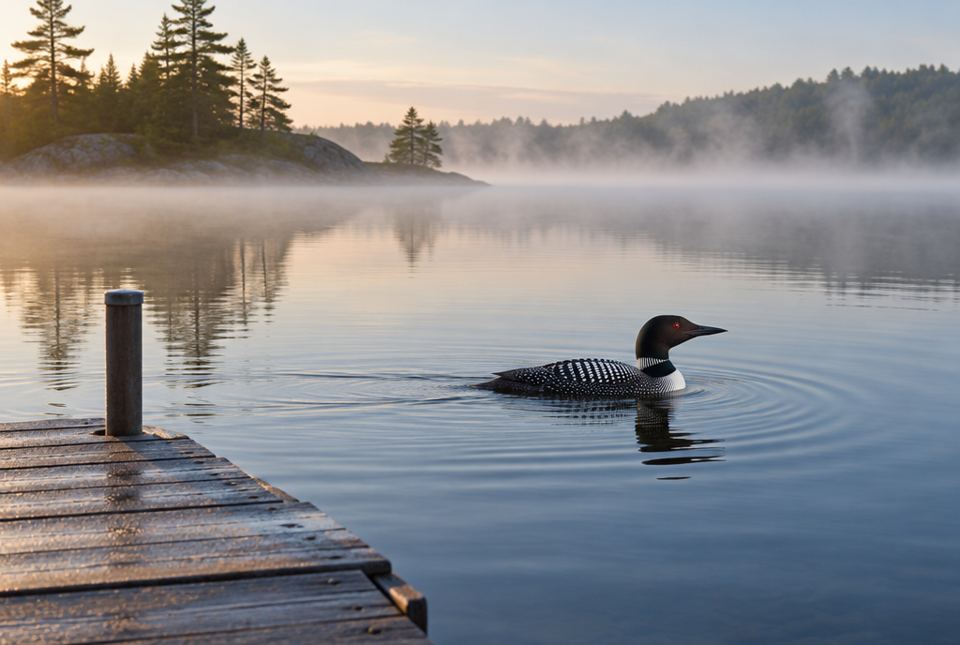 Compare this photo with the text Morning on the Lake. Which details did the writer's imagery help you picture before you saw it? AI-generated image
Worked exampleLet's find the imagery
Find imagery for each sense in Morning on the Lake and explain the effect.
- Sight: Mist rose off the lake like steam from a cup of tea (a simile). The water was a sheet of glass (a metaphor): calm and perfectly smooth. Rings spread out.
- Sound: a loon's call wobbled across it, long and lonely; Plip (onomatopoeia, a word that imitates a sound).
- Touch: The dock boards were cold and damp under my bare feet.
- Smell and taste: frying bacon... the salty smell.
- Effect: you feel like you're standing on the dock. The calm images create a peaceful, quiet mood, and lonely adds a touch of wonder or sadness.
Imagery for sight, sound, touch, smell and taste puts the reader in the scene and creates a peaceful mood.
Imagery in Morning on the Lake, sorted by sense. When a writer appeals to several senses, you feel as if you are standing on the dock.Kinds of humour
Writers make us laugh in different ways:
- Exaggeration (hyperbole): My backpack weighs a thousand kilograms.
- Wordplay and puns: Why didn't the skeleton go to the dance? He had no body to go with. (Nobody and no body sound alike.)
- Surprise: the ending is not what you expect.
- Funny situations: characters in silly or awkward moments.
- Irony: the opposite of what you expect happens: The fire station burned down.
- Funny comparisons: He ate like a vacuum cleaner.
The Perfect Plan (written for this website)
Devon had a perfect plan to make breakfast in bed for his mom's birthday. He would be quiet as a mouse. He would be fast as a cheetah. He would be the greatest chef in the history of the universe.
At 6 a.m., he tiptoed into the kitchen. He dropped the frying pan. CLANG! He stepped on the cat. MRROWW! The toast popped up so high it almost hit the ceiling, and the smoke alarm began to sing its terrible song.
Mom appeared in the doorway in her pyjamas, hair sticking up like a broken umbrella.
"Surprise!" said Devon, holding out a plate of toast as black as a hockey puck.
Mom looked at the toast. She looked at the cat. She looked at Devon. Then she laughed until she had to sit on the floor. "Best birthday breakfast ever," she said.
Worked exampleLet's analyze the humour
Find four kinds of humour in The Perfect Plan and explain how they create meaning.
- Exaggeration: the greatest chef in the history of the universe; toast popped up so high it almost hit the ceiling. The big claims make his failure funnier.
- Irony: he plans to be quiet as a mouse, and then makes the loudest noise possible (CLANG! MRROWW! and the smoke alarm). The opposite of what he planned!
- Funny comparisons: hair like a broken umbrella; toast as black as a hockey puck.
- Funny situation and surprise ending: everything goes wrong, but Mom laughs and calls it the best birthday breakfast ever. We expect her to be upset.
- Meaning: the humour makes a warm point: love and effort matter more than perfection.
Exaggeration, irony, funny comparisons and a surprise ending make the story funny and help show the message: effort and love matter more than a perfect plan.
The humour in The Perfect Plan comes from irony: every part of the plan turns into its opposite. Exaggeration makes the gap even funnier.| Device | Suits this purpose and audience | Might NOT suit |
|---|
| Rich imagery | Poems, descriptive stories, travel writing: readers want to experience a place | Instructions for building a shelf: readers need clear steps |
| Puns and wordplay | Joke books, comics, picture books, ads | A serious news report about a flood |
| Exaggeration | Funny stories and tall tales | A science report, where exact facts matter |
| Gentle humour | A speech to relax an audience; a story about a family | A text about a sad or serious event, unless handled with great care |
Just for funI tried to write a joke about imagery, but you really had to see it, hear it, smell it and feel it to get it.
Humour and respect
Good humour laughs with people, not at them. Jokes that make fun of someone's culture, body, language or abilities are hurtful, not funny. When you analyze humour, ask: Who is laughing, and is anyone hurt?
Hands-on activitySense walk and joke lab
You need: a notebook, a pencil, and a grown-up for a short walk outside (dress for the weather).
- Sense walk: stand still for 2 minutes. Write one detail for each sense: see, hear, smell, touch (and taste if you're having a snack).
- Turn your notes into a 4-sentence paragraph with one simile and one metaphor.
- Joke lab: find or write 3 jokes: one pun, one exaggeration, one surprise ending. Test them on your family. Which got the biggest laugh? Why?
- Read your sense paragraph and your jokes aloud. How do the two kinds of writing make listeners feel differently?
Your turn
1Find a simile in Morning on the Lake.
Mist rose off the lake like steam from a cup of tea.
2Find a metaphor in Morning on the Lake. What does it mean?
The water was a sheet of glass: the lake was calm and perfectly smooth.
3Which sense does salty smell appeal to?
4Find an example of exaggeration in The Perfect Plan.
the greatest chef in the history of the universe (or toast popped up so high it almost hit the ceiling).
5Explain the irony in The Perfect Plan.
Devon planned to be quiet as a mouse, but he made lots of noise (dropped pan, stepped on cat, smoke alarm), the opposite of his plan.
6Why does the pun about the skeleton work?
No body (no body at all) sounds like nobody (no person). The two meanings create the joke.
7What mood does the imagery in Morning on the Lake create?
Peaceful, calm and quiet, with a touch of loneliness or wonder from the loon's call.
More practice: warm-up
Descriptive language that helps you see, hear, smell, taste or feel in your mind.
2Is as brave as a lion a simile or a metaphor?
Big exaggeration for effect.
4Is Plip an example of a sound word?
Yes: it is onomatopoeia, a word that imitates a sound.
Any one: exaggeration, puns, surprise, funny situations, irony, funny comparisons.
More practice: on your own
1Turn this plain sentence into imagery: It was a cold day.
Example: The wind bit my cheeks, and my breath hung in the air like little clouds.
2Why would puns not suit a news report about a house fire?
The topic is serious and people may be hurt. Jokes would be disrespectful and would confuse the purpose: to inform.
3How does the surprise ending of The Perfect Plan change the story's meaning?
Instead of a disaster, it becomes a story about love: Mom values Devon's effort, not perfect toast.
Example: I'm reading a book about anti-gravity. It's impossible to put down! (Look for a word with two meanings.)
5Explain how one simile in The Perfect Plan adds humour.
Hair sticking up like a broken umbrella: you picture wild, spiky hair, a funny image that shows how surprised and sleepy Mom is.
Challenge
1Write a 3-sentence funny scene that uses exaggeration and a surprise ending.
Example: Liam spent three hundred years building the tallest snowman in Canada. It reached the clouds. Then his little sister sneezed and it fell over. (Look for exaggeration and an unexpected ending.)
2A tourism ad for a northern Ontario lake uses rich imagery. Explain why imagery suits that purpose and audience.
Purpose: to make people want to visit. Audience: travellers. Imagery helps them imagine being there (the smell of pine, the cool water, the loon's call), so they want the experience.
3Can one text use both imagery and humour? Explain with an example from this lesson.
Yes. The Perfect Plan uses sound imagery (CLANG! MRROWW!) and visual imagery (toast as black as a hockey puck) that are also funny. Imagery makes the humour vivid.
Quiz
1. The snow was a white blanket over the town. This is a...
3. I'm so hungry I could eat a moose! is an example of...
5. A fire station burns down. What kind of humour or device is this?
6. Which text would probably NOT use puns?
What this lesson teaches: Grade 5 students describe literary devices, including imagery and humour, and explain how they help create meaning and suit the purpose and audience (C3.1).
How to help at home:
- Share favourite jokes and ask "What kind of humour is it?"
- When reading, stop at a great description and ask "Which senses does it use?"
- Talk about humour that is kind versus hurtful.
Common difficulties:
- Simile vs. metaphor. Look for like or as.
- Explaining the effect. Ask "How does it make you feel, and why did the author choose it?"
- Irony is tricky; keep to clear opposite of what you expect examples.
About the texts: All passages were written for this site.