B. Drama / D. Visual Arts · Drama and Visual ArtsVisual Arts: Shapes and Space
D1.1 D1.3 D2.2About 45 minutes
Learning goals- I can find positive and negative shapes and space in art.
- I can make a design with radial symmetry.
- I can explain how a shape changes when I see it from the top, side or bottom.
- I can show near and far using size, placement and overlapping (diminishing perspective).
- I can make art about my own interests using shapes and space.
Words to know
positive shape
The shape of the object itself: the "thing" you notice first.
negative space
The empty space around and between objects. The shapes it makes are called negative shapes.
radial symmetry
A design that spreads out from a centre point, like spokes on a wheel, a snowflake or a flower.
mosaic
A picture made from many small pieces (tiles, stones, glass or paper squares) placed close together.
abstract shape
A shape that doesn't look exactly like a real thing; it may be simplified or made up.
point of view
The place you look from: the top, the side, the bottom or the front.
diminishing perspective
Showing distance by making things smaller, placing them higher on the page and overlapping them as they go farther away.
Remember from Grade 3
You used composite, symmetrical and asymmetrical shapes, and you showed depth with the foreground, middle ground and background. This year you'll discover the hidden shapes in the empty spaces, design with radial symmetry, and learn more tricks for showing near and far.
The secret shape
Look at the space between your fingers when you spread your hand on the table. Those little gaps have shapes too! Or look at the gap between two chairs facing each other.
Artists notice both: the object and the space around it.
Positive and negative
- The positive shape is the object itself: the leaf, the person, the cup.
- The negative space is the empty area around and between objects. It makes negative shapes.
In good art, the negative space is planned too. If you cut a leaf shape out of a square of paper, you get two art pieces: the leaf (positive) and the square with a leaf-shaped hole (negative)!
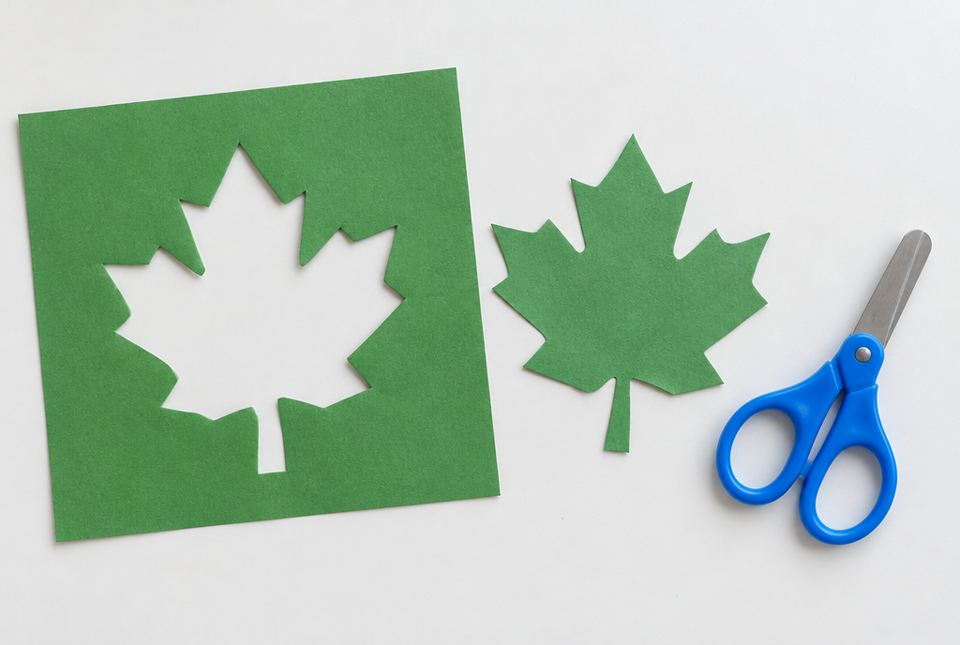 Cutting one shape out of paper gives you two pieces: the leaf is the positive shape, and the hole in the square is the negative space. AI-generated imageLeft: a leaf shape (positive shape). Middle: a square with a leaf-shaped hole cut out (negative space). Right: a flower design with eight petals spreading from a centre circle (radial symmetry).
Radial symmetry and mosaics
Radial symmetry spreads out from a centre point, like the petals of a flower, a snowflake, a bicycle wheel, a sliced orange or a spider web. If you turn the design, it looks the same in many directions.
Examples in art:
- Star blankets (star quilts): many First Nations of the Plains make quilts with a large eight-pointed star made from many small diamond-shaped pieces of fabric. Star blankets are often given to honour a person at an important event.
- Mandalas in Hindu and Buddhist art are circular designs with radial symmetry.
- Many rose windows in old churches spread out from the centre like a flower.
A mosaic is a picture made of many small pieces placed close together, like tiles, pebbles, coloured glass or paper squares. Ancient Romans made mosaic floors from tiny stone tiles. A star blanket, made of many small pieces, is a bit like a fabric mosaic!
Shapes change with point of view
Hold a mug. Look at it from the side: it's a rectangle with a handle. From the top: a circle (a ring). From the bottom: a circle again, but filled in.
The same object makes different shapes depending on your point of view. Artists choose a point of view on purpose. A bird's-eye view (from the top) can make a scene feel like a map. A worm's-eye view (from the bottom) makes things look tall and powerful.
| Object | From the side | From the top | From the bottom |
|---|
| a mug | rectangle with a handle | ring (circle with a hole) | filled circle |
| a pine cone standing up | a tall oval or triangle shape | a circle with a spiral pattern | a circle with a stem in the middle |
| a canoe | long, thin, curved like a smile | long, pointed at both ends, like a leaf | a long, narrow shape like a leaf |
Just for funRiddle: I have radial symmetry, I come in slices, and I'm very juicy. What am I?
An orange, cut across the middle!
Showing near and far: diminishing perspective
Diminishing means "getting smaller." In diminishing perspective, objects get smaller as they go farther away. Three tricks work together:
- Size: far things are drawn smaller.
- Vertical placement: far things are placed higher on the page, closer to the horizon line.
- Overlapping: near things cover part of far things.
A road or train track also narrows as it goes back toward the horizon.
Worked exampleExample: Planning a positive and negative design
Let's make a positive and negative design about something you love: hockey.
- Draw a simple, bold shape: a hockey stick and puck, or a skate. Keep the outline simple so it's easy to cut.
- Cut it out carefully from the middle of a square of coloured paper (a grown-up can help start the cut).
- Glue the square with the hole (negative) on one half of a big paper, and the cut-out shape (positive) on the other half, like a mirror.
- Look: the two halves are opposites. Where one has colour, the other has empty space.
- Explain: "I used positive and negative shapes to show my interest in hockey. The negative space is as important as the shape."
One cut gives two art pieces: the positive shape and the negative space.
Worked exampleExample: Analyzing space in a landscape
Let's look at a winter landscape of a forest with a frozen river, and explain how the artist showed depth.
- Size: the pine trees at the bottom of the page are tall; the trees near the horizon are tiny.
- Vertical placement: the far trees sit higher on the page.
- Overlapping: a big snowbank covers part of the river, so it seems closer.
- The river narrows as it winds back toward the hills.
- Say it: "The artist used diminishing perspective: smaller, higher and overlapped shapes, so the forest looks deep."
We named the tricks (size, placement, overlapping) and explained the effect: depth.
Hands-on activityRadial snowflake or flower design
You need: a paper plate or a circle traced from a bowl, a pencil, a ruler, markers or crayons, scissors (with a grown-up's help), and coloured paper or magazine pages.
- Find the centre of your circle and mark it with a dot.
- With the ruler, draw lines through the centre to divide the circle into 8 equal parts (like a pizza).
- Draw a small shape in one section, near the centre. Repeat the same shape in every section.
- Add another ring of shapes, a bit farther out. Repeat it in every section again. Keep going to the edge.
- Colour it so that matching shapes have matching colours. Turn your design: does it look the same from many directions?
- Mosaic option: cut coloured paper into small squares (about 1 cm) and glue them close together to fill your shapes, leaving tiny gaps, like a mosaic.
Bonus: draw an object you love from the top, the side and the bottom in three boxes.
Your turn
The empty space around and between objects.
2Name two things in nature with radial symmetry.
Any two: a snowflake, a daisy or sunflower, a sliced orange, a starfish, a spider web.
A picture made of many small pieces placed close together.
4Draw a cup from the top and from the side. What shapes do you see?
From the top: a circle or ring. From the side: a rectangle (with a handle if it has one).
5Name the three tricks of diminishing perspective.
Size (far = smaller), vertical placement (far = higher), overlapping (near covers far).
6In a drawing, a tree near the top of the page is very small. Is it near or far?
Far. Small and high means far away.
7What is an abstract shape?
A shape that doesn't look exactly like a real thing; it may be simplified or made up.
More practice: warm-up
1True or false: The positive shape is the object itself.
2What does diminishing mean?
3Where is the centre of a radial design?
In the middle; the design spreads out from there.
4Find one thing at home with radial symmetry.
Examples: a wheel, a clock face, a bowl's pattern, a fan, a sliced onion or apple, a flower in a pot.
5Things far away are drawn ___ (bigger or smaller).
More practice: on your own
1Explain how cutting a shape out of paper gives you two art pieces.
You get the cut-out shape (positive) and the paper with a shape-hole (negative). Both can be used in art.
2Why might an artist draw a building from a worm's-eye view (from the bottom)?
It makes the building look tall, huge and powerful, because we're looking up at it.
3Describe how a star blanket shows radial symmetry.
The large eight-pointed star spreads out from the centre, and each point looks the same as the others, so the design repeats around the middle.
4A drawing has a big moose at the bottom covering part of a smaller hill. Which perspective trick is used? Name two.
Size (the moose is big because it's near), overlapping (the moose covers the hill), and vertical placement (the moose is low on the page).
5Draw (or describe) a canoe from the top and from the side.
Top: a long shape pointed at both ends, like a leaf. Side: a long, thin shape that curves up at the ends, like a smile.
Challenge
1Plan a picture about your favourite activity that uses diminishing perspective. Describe what is near and what is far, and how you show it.
Example: "Me cross-country skiing. Near: me, big and low on the page, overlapping the trail. Far: tiny pine trees and a cabin high up near the horizon. The ski trail narrows as it goes back." Look for size, placement and overlapping.
2Look at a picture of a crowd or a forest. Why is the negative space important in art?
The negative space separates shapes so they can be seen clearly, gives the eye a place to rest, and makes its own shapes that can be interesting. Too little negative space can make art feel crowded; lots can feel calm or lonely.
3Design a radial design that shows something about your family or culture. Describe its centre and its repeating parts.
Example: "In the centre, a heart for my family. Around it, 8 maple leaves for Canada, then a ring of 8 small stars, one for each person in my family, repeated around the circle." Look for a centre, rings that repeat, and personal meaning.
Quiz
1. The empty space around an object is called ___.
2. Which has radial symmetry?
3. A picture made from many small tiles is a ___.
4. From the top, a drinking glass looks like a ___.
5. In diminishing perspective, things far away are drawn ___.
6. A big tree covers part of a small house behind it. This trick is called ___.
Big idea: The Grade 4 focus for shape and form includes positive and negative shapes, shapes organized in radial symmetry or in a mosaic, changes in shapes depending on point of view, and abstract shapes. For space, it includes positive and negative space and diminishing perspective (vertical placement, diminishing size, overlapping) to create the illusion of depth. Students create art inspired by their interests (D1.1), use elements of design to communicate (D1.3), and explain how artists use them (D2.2).
How to help:
- Play "Find the negative shape": look at the spaces between chair legs, tree branches or letters on signs.
- On walks, notice how far-away trees and houses look smaller and higher. Take a photo and point it out.
- Look at star blankets, quilts and mandalas in books or museum websites, and count the repeating parts.
Safety: supervise scissors, especially when starting a cut in the middle of the paper.
Common difficulties:
- Placing far objects lower on the page. Draw a horizon line first and say: "Far things live close to this line."
- Uneven radial sections. Fold a paper circle in half three times to get 8 equal sections instead of measuring.
- Ignoring negative space. Try drawing only the spaces between the legs of a chair: it's a great eye-opener.