B. People and Environments · Political and Physical Regions of CanadaThe North: The Arctic Lowlands and the Innuitian Mountains
B3 B1About 40 minutes
Learning goals- I can describe the land, climate and vegetation of the Arctic Lowlands and the Innuitian Mountains.
- I can explain what permafrost and tundra are.
- I can describe how Inuit live in the Arctic today.
- I can explain how the cold climate affects travel, buildings and jobs.
Words to know
Arctic
The cold region around the North Pole.
tundra
Cold, treeless land with small plants.
permafrost
Ground that stays frozen all year.
polar desert
A cold place where very little rain or snow falls.
Inuit Nunangat
The Inuit homeland in Canada, with four regions.
country food
Food from the land and sea, such as caribou, seal and Arctic char.
sealift
Ships that bring supplies to northern communities in summer.
Remember from Grade 2
In Grade 2 you visited Iqaluit, the capital of Nunavut, and learned how Inuit families live there today. Now we travel even farther north, to the Arctic islands, to explore Canada's two most northern physical regions.
The Arctic Lowlands
Where: many of the islands in Canada's Arctic, in Nunavut and the Northwest Territories, such as Victoria Island.
Land: low and flat plains. The ground is permafrost: frozen all year, except for a thin top layer that thaws in summer. Because the water can't soak down into the frozen ground, many shallow lakes and ponds appear in summer.
Climate: long, very cold winters and short, cool summers. Very little rain or snow falls, so some scientists call it a polar desert. Far in the north, the sun doesn't rise for days, weeks or even months in winter, and doesn't set for days, weeks or even months in summer (the midnight sun).
Vegetation: tundra. No trees grow here. There are mosses, lichens, grasses, small flowers and tiny shrubs like the Arctic willow, which grows close to the ground.
The Innuitian Mountains
Where: the most northern islands of Nunavut, such as Ellesmere Island and Axel Heiberg Island.
Land: high, rugged mountains, deep valleys and fiords, with glaciers and ice caps that stay all year.
Climate: the coldest region in Canada, and very dry.
Vegetation: very few plants, mostly in sheltered valleys.
Very few people live here. Grise Fiord, on Ellesmere Island, is one of Canada's most northern communities. Its Inuktitut name, Aujuittuq, means "place that never thaws." Quttinirpaaq National Park protects part of Ellesmere Island.
Arctic wildlife
Animals have adapted to the cold: caribou, muskoxen, Arctic foxes, Arctic hares, snowy owls, and in the sea, seals, walrus, narwhal, beluga whales and fish like Arctic char. Polar bears hunt seals on the sea ice.
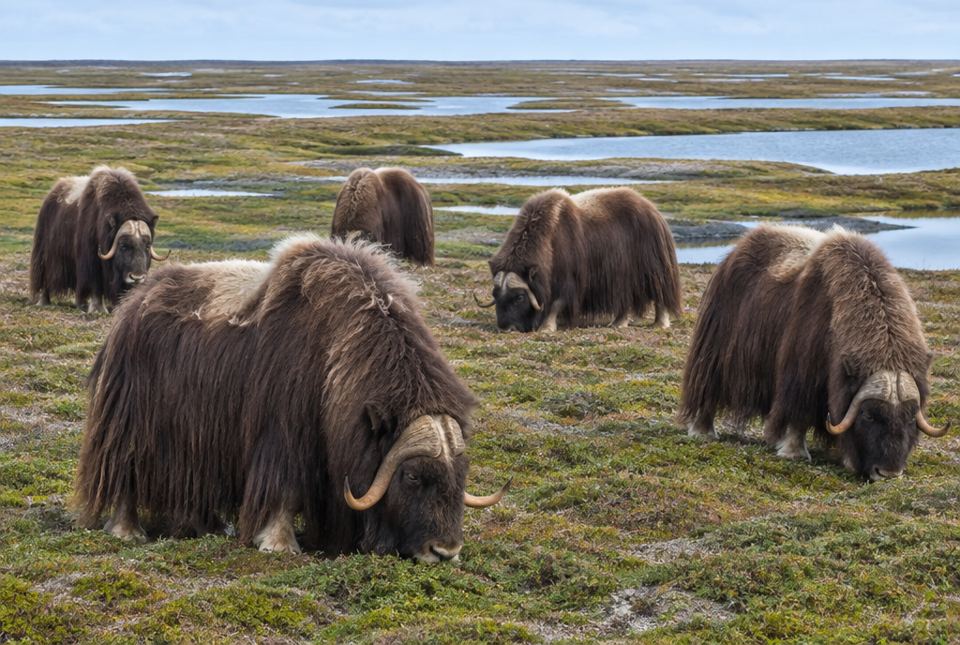 Muskoxen are well adapted to the cold, with very long, thick coats. Notice the many shallow ponds: water cannot soak into the frozen permafrost below. AI-generated image
Inuit: the people of the Arctic
Inuit have lived in the Arctic for many hundreds of years, and they live there today. The Inuit homeland is called Inuit Nunangat. It has four regions:
- Inuvialuit Settlement Region (Northwest Territories and Yukon's north coast)
- Nunavut
- Nunavik (northern Quebec)
- Nunatsiavut (northern Labrador)
Communities include Cambridge Bay (Iqaluktuuttiaq) on Victoria Island and Grise Fiord (Aujuittuq). Inuit speak Inuktut, which includes Inuktitut and Inuinnaqtun.
Life today:
- Families live in modern houses and go to school, work, the store, the health centre and the hockey arena. (In Inuktitut, iglu means any house. Some people still know how to build a snow house as a shelter when out on the land.)
- Many families hunt and fish for country food such as caribou, seal and Arctic char, and share it with others.
- People travel by snowmobile, ATV, boat and plane. There are no roads joining most communities to southern Canada. Big sealift ships bring supplies like building materials and fuel in summer, when the sea ice has melted.
- Jobs include teaching, nursing, government work, stores, mining, tourism, hunting guides, and art. Kinngait (Cape Dorset) is famous for Inuit prints and carvings.
Inuit Qaujimajatuqangit means Inuit knowledge, values and ways of doing things. The Government of Nunavut includes these values in its work.
A changing Arctic
The Arctic is warming faster than most of the world. Sea ice is getting thinner and forms later in the fall, which makes travelling and hunting on the ice less safe. Thawing permafrost can crack buildings and roads. Inuit knowledge of the land and ice is helping scientists and communities track these changes.
Just for funRiddle: Where can you eat breakfast, lunch and supper in the sunshine, and then go to bed in it too?
The Arctic in summer, under the midnight sun! (Good thing curtains exist.)
Worked exampleLet's explain a surprise
The Arctic Lowlands get very little rain or snow, but in summer there are lots of ponds. How can a dry place have so many ponds?
- Think about the permafrost: under the thin top layer, the ground is frozen solid.
- When snow melts in spring, the water can't soak down through frozen ground.
- The land is flat, so water doesn't run away quickly. It sits in shallow ponds.
Permafrost traps the meltwater on top of the flat land, so ponds form even though little rain or snow falls.
Worked exampleLet's connect land and life
Why do supply ships only go to many Arctic communities in summer?
- In winter, the sea is covered with thick sea ice.
- Large ships can't sail through thick ice safely.
- In summer, much of the ice melts, and ships can reach the communities.
The sea is only open water in summer, so the sealift ships come then (often just once or a few times each summer). Planes bring supplies in other seasons.
Hands-on activityDesign a building for permafrost
You need: a tray, a damp sponge or a cup of wet sand (frozen in the freezer overnight with a grown-up's help), a small block or toy house (or a small plastic container of warm tap water, to act as a heated house), and some popsicle sticks. A grown-up should help with the freezer and frozen sand.
- Take out the frozen sand (your permafrost). Put the toy house directly on top.
- Wait 20 to 30 minutes while it starts to thaw. What happens to the house? Does it tilt or sink?
- Try again with a fresh cup of wet sand. Before you freeze it, push four popsicle sticks (your stilts) deep into the wet sand, then freeze it overnight. Stand the house on the popsicle-stick legs, with a gap under the house.
- Compare. In the North, many buildings sit on posts or stilts so the warm building doesn't melt the frozen ground under it.
What to look for: Your child explains that heat from a building can thaw permafrost and make the ground soft, and stilts help keep the ground frozen.
Your turn
1What is the natural vegetation of the Arctic Lowlands called?
2Why don't trees grow in the Arctic Lowlands?
It is too cold, the growing season is too short, and the permafrost stops deep roots.
3Which region is the most northern and has glaciers and ice caps?
4What is the Inuit homeland called?
5Name two kinds of country food.
Any two: caribou, seal, Arctic char (or other fish), muktuk (whale skin and fat).
6What is the midnight sun?
When the sun doesn't set at night for days, weeks or even months in the far north in summer.
Ships that bring supplies like fuel and building materials to Arctic communities in summer.
More practice: warm-up
1Is the land of the Arctic Lowlands flat or mountainous?
2Name an animal that lives in the Arctic.
Any one: caribou, muskox, Arctic fox, polar bear, seal, walrus, narwhal, snowy owl.
3What language do many Inuit speak?
Inuktut (such as Inuktitut or Inuinnaqtun).
4What does iglu mean in Inuktitut?
5Name the four regions of Inuit Nunangat.
Inuvialuit Settlement Region, Nunavut, Nunavik and Nunatsiavut.
More practice: on your own
1Why do some scientists call the Arctic a polar desert?
Because very little rain or snow falls there, like in a desert, even though it is cold.
2Why does a building in the Arctic often stand on posts or stilts?
So the heat from the building doesn't thaw the permafrost underneath. Thawing ground gets soft, and the building could tilt or crack.
3How is thinner sea ice a problem for Inuit hunters?
People travel and hunt on the sea ice. Thin or unpredictable ice is dangerous to travel on and makes it harder to reach animals like seals.
4Grise Fiord's Inuktitut name means "place that never thaws." What does that tell you about the climate there?
It is very cold, even in summer, with ice and frozen ground most of the year.
5Name two jobs people do in Arctic communities today.
Any two: teacher, nurse, government worker, store worker, miner, hunting or tourism guide, artist, pilot.
Challenge
1Explain how the sea ice is like a highway for Inuit and for polar bears.
In winter, the sea ice lets Inuit travel by snowmobile or dog team between communities and to hunting areas. Polar bears walk and hunt seals on the ice. When the ice melts or thins, both lose their "highway."
2A store in a northern community and a store in Toronto sell the same box of cereal. Why does it often cost much more up north?
Most goods must come by plane or by sealift ships in summer, which is expensive. The community is small and far away, and there are no roads, so moving goods costs more.
3Why is Inuit knowledge important for understanding a changing Arctic?
Inuit have watched the land, ice, weather and animals for many generations and share that knowledge over time. They notice changes that scientists might miss, like when ice forms or how animals move. Working together gives a fuller picture.
Quiz
1. Ground that is frozen all year is called...
2. Which is the most northern physical region?
3. Which plants grow on the tundra?
4. What is the Inuit homeland called?
5. Why do supply ships reach many Arctic communities only in summer?
6. How do most Inuit families live today?
Big idea: The Arctic Lowlands (flat islands, tundra, permafrost, polar desert) and the Innuitian Mountains (the most northern, mountainous, glaciers and ice caps) are Canada's coldest regions. Inuit live throughout Inuit Nunangat in modern communities and keep strong ties to the land, sea ice and country food. The Arctic is changing quickly as the climate warms.
How to help at home:
- Read a book by an Inuit author or illustrator (Inhabit Media, an Inuit-owned publisher in Iqaluit, has many children's books).
- Look up the sunrise and sunset times for Iqaluit or Cambridge Bay in June and December and compare them with your town.
- Talk about how families everywhere adapt to their climate: clothing, houses, travel.
Common difficulties and stereotypes to avoid:
- "Inuit live in igloos." Inuit live in houses in modern communities; iglu means "house."
- Using "Eskimo". This term is outdated and considered offensive by many Inuit; use "Inuit" (plural) and "Inuk" (one person).
- Thinking the Arctic has no summer. Summers are short and cool, with long daylight.
Safety: A grown-up should handle the freezer and frozen sand in the activity.