D. Structures and Mechanisms · Machines and MechanismsChanging Speed with Gears, Chains and Belts
D2.3 D2.4 D2.5 A1.2 A2.1About 45 minutes
Learning goals- I can count gear teeth to predict how many times a follower gear turns.
- I can explain that a big gear turning a small gear makes the small gear turn faster.
- I can explain that a small gear turning a big gear makes the big gear turn slower but with a stronger turning force.
- I can explain how belts and chains transmit motion and change speed, and how a crossed belt changes direction.
- I can use code to calculate gear turns.
Words to know
speed
How fast something moves or turns.
turn (revolution)
One whole trip around in a circle.
gear ratio
A comparison of the number of teeth on two meshing gears. It tells how many times the follower turns for each turn of the driver.
turning force
How strongly something turns. A wheel with a strong turning force can turn something that is hard to turn.
sprocket
A gear with teeth that fit into a chain.
belt drive
Two pulleys joined by a belt so one turns the other.
crossed belt
A belt that makes a figure eight between two pulleys, so they turn in opposite directions.
The hill and the flat road
Leo rides his bike with lots of gears. On the flat bike path beside the lake, he picks a gear that makes him go fast. On a steep hill, he switches to a gear that makes pedalling easier, but slower. How can gears do both? Let's count teeth!
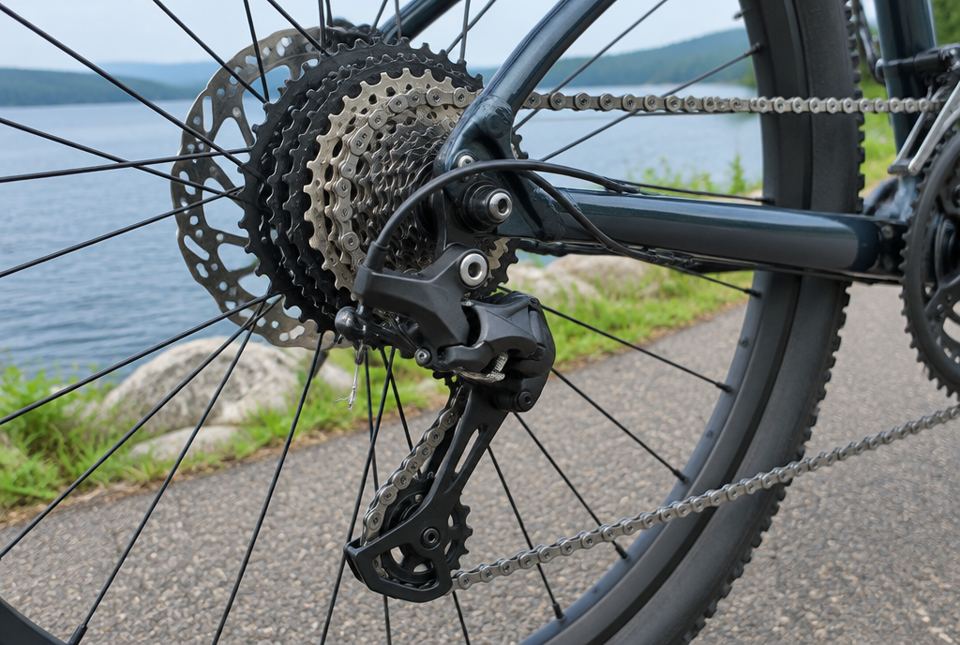 The back wheel of a bike has a stack of gears with different numbers of teeth. Moving the chain to a bigger back gear makes pedalling easier but slower, like Leo on the hill. AI-generated image
Count the teeth
When two gears mesh, every tooth of the driver pushes one tooth of the follower. So the same number of teeth pass by on both gears.
If the driver has 24 teeth and the follower has 8 teeth:
- One turn of the driver moves 24 teeth past the meeting point.
- The follower has only 8 teeth, so 24 teeth is 3 whole turns (24 ÷ 8 = 3).
The little follower turns 3 times for every 1 turn of the big driver. It turns faster.
The turn rule
Follower turns = driver turns × driver teeth ÷ follower teeth
- Big driver, small follower: follower turns faster (but with less turning force).
- Small driver, big follower: follower turns slower (but with more turning force).
- Same size: same speed.
Worked exampleLet's count: small driver, big follower
A 12-tooth driver turns a 24-tooth follower. The driver turns 4 times. How many times does the follower turn?
- Teeth passed: 4 turns × 12 teeth = 48 teeth.
- Follower turns: 48 ÷ 24 = 2 turns.
- The follower turns slower than the driver (2 turns instead of 4).
The follower turns 2 times. It is slower, but it turns with more force, like the easy hill gear on a bike.
Trading speed for force
Gears can't make something faster and stronger at the same time. It is a trade-off, just like pulleys:
- To get more turning force, the follower turns slower. Use a small driver and a big follower. A crank winch uses this to pull a heavy boat onto a trailer. A bike's hill gear is like this.
- To get more speed, the follower turns with less force. Use a big driver and a small follower. A hand egg beater uses this: a slow turn of the crank makes the beaters spin fast.
Chains and sprockets
On a bike, the chain joins the front chainring (the driver) to the back sprocket (the follower). The chain moves one link for each tooth, so the counting rule works the same way.
- A 36-tooth chainring and a 12-tooth sprocket: one pedal turn turns the back wheel 36 ÷ 12 = 3 times. Fast on flat ground, but harder to pedal.
- A 24-tooth chainring and a 24-tooth sprocket: one pedal turn turns the back wheel 1 time. Slower, but much easier to pedal up a hill.
The chain keeps both gears turning the same direction.
Belts and pulleys
A belt drive is like a chain, but it uses a smooth rubber belt in the grooves of two pulleys. You find belt drives in some sewing machines, some treadmills and car engines.
- A small pulley turning a big pulley: the big one turns slower.
- A big pulley turning a small pulley: the small one turns faster.
- If the big pulley is 3 times as wide as the small one, the small one turns 3 times for each turn of the big one.
An open belt keeps both pulleys turning the same direction. A crossed belt (a figure eight) makes them turn opposite directions.
Worked exampleLet's work out the egg beater
Suppose a hand egg beater's crank gear has 36 teeth. Each beater's small gear has 9 teeth. You turn the crank 2 times. How many times does each beater turn?
- Teeth passed: 2 × 36 = 72 teeth.
- Beater turns: 72 ÷ 9 = 8 turns.
- The beaters turn 4 times as fast as the crank.
Each beater turns 8 times. A big driver and a small follower make the beaters spin fast (with less force, which is fine for mixing eggs).
Just for funIn a bike's easiest hill gear, your legs can spin round and round like an egg beater while the bike crawls up the hill like a snail. It looks silly, but it's science: lots of turns, less speed, more force!
Code it: a gear calculator
set driverTeeth to 36
set followerTeeth to 12
set driverTurns to 1
set followerTurns to driverTurns × driverTeeth ÷ followerTeeth
say "The follower turns " + followerTurns + " times"
if followerTeeth < driverTeeth then
say "Faster, with less turning force"
else if followerTeeth > driverTeeth then
say "Slower, with more turning force"
else
say "Same speed"
Output: The follower turns 3 times. Faster, with less turning force.
Hands-on activitySpool belt drive speed test
You need: 2 round lids or cardboard circles of different sizes (for example, one about 4 cm across and one about 12 cm across), 2 pushpins, a cardboard box as a base, a large elastic band (or a loop of string), a marker and a ruler.
- A grown-up pins each lid to the box through its centre so it spins freely. Place them about 20 cm apart.
- Stretch the elastic band around the edges of both lids as a belt.
- Draw a line from the centre to the edge of each lid, so you can count turns.
- Predict: if you turn the big lid once, how many times will the small lid turn? Measure the widths and divide (big width ÷ small width).
- Test: turn the big lid slowly 5 times and count the small lid's turns. Repeat 3 times. Is it close to your prediction?
- Twist the band into a figure eight (crossed belt). Which way does the small lid turn now?
What to look for: with a 12 cm lid and a 4 cm lid, the small lid turns about 3 times for each turn of the big one (15 turns for 5). The count may be a little less if the band slips. The crossed belt makes the lids turn opposite ways. Safety: a grown-up handles the pushpins.
Your turn
1A 30-tooth driver turns a 10-tooth follower. The driver turns once. How many times does the follower turn?
2A 10-tooth driver turns a 30-tooth follower. How many times must the driver turn to make the follower turn once?
3 times. The follower needs 30 teeth to pass; 30 ÷ 10 = 3 driver turns.
3Which turns faster: a small follower turned by a big driver, or a big follower turned by a small driver?
The small follower turned by a big driver.
4What is the trade-off when a follower turns slower?
It turns with more turning force.
5An open belt joins two pulleys. The first turns clockwise. Which way does the second turn?
Clockwise (the same way).
6A crossed belt joins two pulleys. The first turns clockwise. Which way does the second turn?
Counterclockwise (the opposite way).
7A 20-tooth driver turns a 20-tooth follower. Compare their speeds.
They turn at the same speed: 1 turn for 1 turn.
More practice: warm-up
1A 16-tooth driver turns an 8-tooth follower once. How many follower turns?
2Do two sprockets joined by a chain turn the same way?
A gear whose teeth fit into a chain.
4Big driver, small follower: faster or slower follower?
5What does a belt drive use instead of a chain?
A smooth belt running on pulleys.
More practice: on your own
1A 40-tooth chainring turns a 10-tooth sprocket. How many times does the back wheel turn for 3 pedal turns?
12 times. One pedal turn: 40 ÷ 10 = 4 wheel turns. 3 pedal turns: 3 × 4 = 12.
2Leo is going up a steep hill. Should he choose a chainring and sprocket that are the same size, or a big chainring and a tiny sprocket? Explain.
The same size (or a small chainring with a big sprocket). The wheel turns slower, so pedalling needs less force, which makes the hill easier. A big chainring and tiny sprocket is hard to push uphill.
3A 9-tooth driver turns a 27-tooth follower. The driver turns 6 times. How many times does the follower turn?
2 times. 6 × 9 = 54 teeth; 54 ÷ 27 = 2.
4In the code, set driverTeeth to 10 and followerTeeth to 20. What does the program say?
"The follower turns 0.5 times" (half a turn) and "Slower, with more turning force." 1 × 10 ÷ 20 = 0.5, and 20 is more than 10.
5A sewing machine motor turns a small pulley. A belt turns a big pulley 4 times as wide. The motor's pulley turns 20 times. How many times does the big pulley turn?
5 times. The big pulley turns 4 times slower: 20 ÷ 4 = 5.
Challenge
1Gear A (8 teeth) turns gear B (24 teeth). Gear B turns gear C (12 teeth). Gear A turns 6 times. How many times do B and C turn? Which way does C turn compared to A?
B: 6 × 8 = 48 teeth; 48 ÷ 24 = 2 turns. C: 2 × 24 = 48 teeth; 48 ÷ 12 = 4 turns. C is the 3rd gear (odd), so it turns the same way as A. (Shortcut: B is an idler here, so C turns like a 12-tooth gear driven by an 8-tooth gear: 6 × 8 ÷ 12 = 4.)
2An engineer needs a winch to slowly lift a heavy boat onto a trailer by turning a crank. Should the crank turn a small gear that turns a big gear on the winch drum, or a big gear that turns a small gear? Explain the trade-off.
The crank should turn a small gear that turns a big gear on the drum. The drum turns slower, but with more turning force, so the person can pull the heavy boat. The trade-off: they must turn the crank many times.
3Design a gear pair that makes a toy fan spin 5 times for every turn of a crank. Give possible numbers of teeth and explain.
Any pair where the driver has 5 times as many teeth as the follower. Example: a 50-tooth driver on the crank and a 10-tooth follower on the fan. 50 ÷ 10 = 5 turns of the fan for each crank turn. The fan spins fast with less force, which is fine for a light fan.
Quiz
1. A 24-tooth driver turns an 8-tooth follower once. The follower turns...
2. A small driver turns a big follower. The follower turns...
3. A hand egg beater's beaters spin faster than the crank because...
4. A crossed belt makes two pulleys turn...
5. Which bike set-up is easiest for pedalling up a steep hill?
6. A 10-tooth driver turns 5 times. It meshes with a 25-tooth follower. The follower turns...
7. Gears change speed. They also change...
Big idea (D2.3, D2.4, D2.5): Gears, chains and belts transmit rotary motion and can change its speed and direction, which also changes the turning force. Counting teeth predicts speed: follower turns = driver turns × driver teeth ÷ follower teeth. A crossed belt reverses direction. The gear calculator is A2.1; the belt-drive test is A1.2.
Math link: This lesson uses multiplication and division facts. If a question feels hard, use small numbers first (a 2-tooth difference) or count teeth on a drawing.
How to help: Look at a multi-speed bike together. Count the teeth on a front and back gear (or estimate) and turn the pedal once by hand with the wheel off the ground (a grown-up holds the bike). Count the wheel's turns.
Common difficulties:
- Thinking the bigger gear turns faster. The smaller gear always turns faster in a meshing pair.
- Expecting faster and stronger at the same time. It is always a trade-off.
- Safety: keep fingers away from a turning bike chain and spokes.