B. Life Systems · Habitats and CommunitiesFood Webs: Food Chains Connected
B2.4 B2.3 A1.5About 40 minutes
Learning goals- I can explain that a food web is many food chains connected together.
- I can find the food chains inside a food web.
- I can predict what might happen to a community when one population changes.
- I can draw and explain a food web for an Ontario habitat.
Words to know
food web
Many food chains in a community that are joined together because animals eat more than one kind of food.
interconnected
Joined together so that a change in one part affects other parts.
balance
When the populations in a community stay about the same size over time.
predict
To say what you think will happen, using what you know.
A fox's menu
In the last lesson, our food chains were straight lines. But think about a red fox. Does it eat only one thing? No! A fox eats mice, rabbits, birds, insects and even berries.
And a mouse is eaten by foxes, owls, hawks and snakes. Real communities are messier than one straight chain.
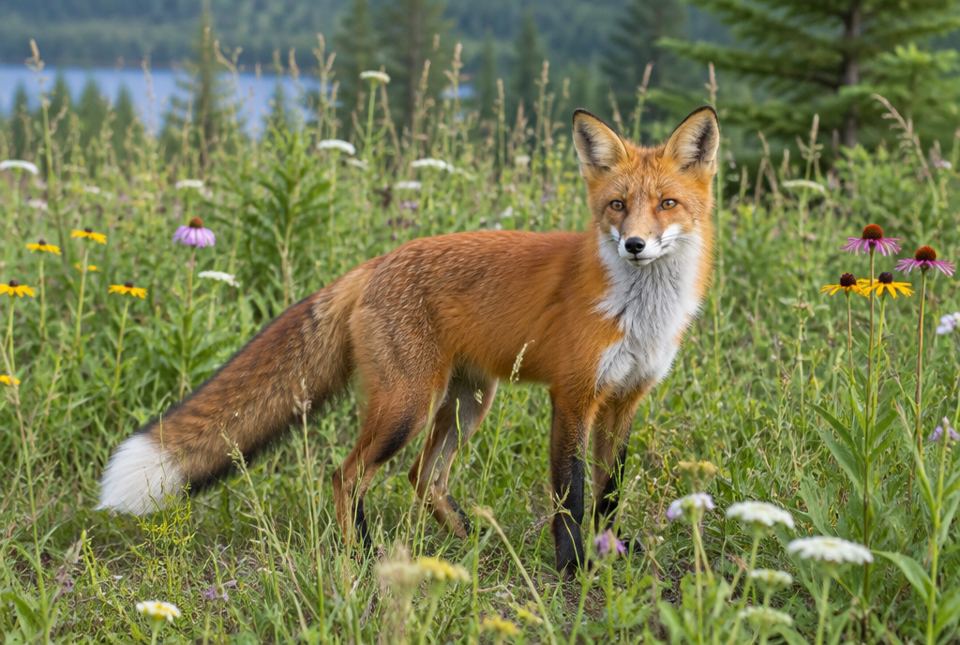 A red fox eats mice, rabbits, birds, insects and berries, so it is part of many food chains at once. AI-generated image
From chains to a web
When we join all the food chains in a community, the lines cross and connect, like a spider's web. This is called a food web.
A food web shows many food chains that are interconnected in a natural community. The arrows still point toward the eater.
Worked exampleLet's find the food chains in the web
How many food chains are in the meadow food web above? List them.
- Start at each producer at the bottom and follow every arrow path up to the end.
- From grass: grass → grasshopper → mouse → owl, and grass → grasshopper → mouse → fox. (2 chains)
- From the oak tree (its acorns): oak tree → mouse → owl, and oak tree → mouse → fox. (2 chains)
- From clover: clover → rabbit → fox, and clover → rabbit → owl. (2 chains)
- Add them up: 2 + 2 + 2.
There are 6 food chains hidden in this one food web.
Why food webs matter: everything is connected
Because the chains are connected, a change to one population can affect many others.
Imagine a disease makes the rabbits disappear from the meadow:
- Clover is not eaten as much, so there may be more clover.
- Foxes and owls lose one of their foods. They hunt more mice.
- So the mouse population may go down.
- With fewer mice eating them, there may be more grasshoppers and more acorns left.
One change ripples through the whole web! In a healthy community, populations usually stay in balance: they go up and down a little but stay about the same over many years.
Webs with many links are stronger
If an animal eats many kinds of food, it can switch when one food runs out. That is why communities with many different species (lots of links) are usually better at surviving changes than communities with only a few species.
Worked exampleLet's predict a change
In the meadow web, what might happen if a farmer cuts all the grass for hay?
- Who eats grass? The grasshopper. Grasshoppers lose their food, so there will be fewer grasshoppers.
- Who eats grasshoppers? The mouse. Mice still have acorns, so they may be okay, but they have less food overall.
- Owls and foxes eat mice. If mice decrease, owls and foxes may eat more rabbits.
Cutting the grass would mean fewer grasshoppers and could put more pressure on mice and rabbits, because the web is interconnected.
Just for funIf you could text a red fox "What's for dinner?", it might reply: "Mice, rabbits, birds, insects... or berries. I'm flexible!" Eating many foods helps it survive when one runs out.
Hands-on activityYarn food web game
You need: a ball of yarn or string, 8 index cards, tape or safety pins, 3 or more players (family members or stuffed animals can hold cards).
- Write one organism from a pond on each card: Sun, algae, cattail, mayfly, tadpole, perch, frog, great blue heron.
- Each player holds a card (stuffed animals can hold extra cards).
- Start with the Sun. Hold the end of the yarn and pass the ball to a producer (algae). Keep passing the yarn from food to eater, holding on each time. (Sun → algae, Sun → cattail, algae → tadpole, algae → mayfly, cattail → mayfly, mayfly → perch, mayfly → frog, tadpole → perch, perch → heron, frog → heron. Young mayflies live underwater and eat algae and bits of dead plants like cattail; perch eat young mayflies, and frogs catch the adult mayflies.)
- When the web is done, the frog player gently tugs. Who feels the tug? Those are the organisms connected to the frog!
- Now the frog "disappears" and lets go. Talk about who is affected.
Share: "When the ___ disappeared, ___ was affected because ___."
Your turn
Many food chains in a community that are connected together.
2Why do food chains connect into webs?
Because most animals eat more than one kind of food, and are eaten by more than one kind of animal.
3In the meadow web, what does the mouse eat?
Acorns from the oak tree and grasshoppers.
4In the meadow web, what eats the rabbit?
5Which organisms are the producers in the meadow web?
Grass, the oak tree and clover.
6Write one food chain from the meadow web that has 4 organisms.
grass → grasshopper → mouse → owl (or → fox).
7If the owls left the meadow, what might happen to the mouse population?
It might increase, because fewer predators are eating mice (though foxes still eat some).
More practice: warm-up
1Do arrows in a food web point toward the food or toward the eater?
2In the meadow web, what does the grasshopper eat?
3Name the two top predators in the meadow web.
4What does "interconnected" mean?
Joined together so a change in one part affects other parts.
5Is a food web found in a community or in one single animal?
More practice: on your own
1How many different foods does the fox eat in the meadow web? Name them.
2Why is the mouse such an important link in the meadow web?
Many paths go through it: it eats acorns and grasshoppers, and is eaten by both the owl and the fox. 4 of the 6 food chains include the mouse.
3A dry summer means fewer acorns. Predict the effect on mice, owls and foxes.
Mice have less food, so there may be fewer mice. Then owls and foxes have fewer mice to eat and may hunt more rabbits.
4Why is a community with many species usually better at surviving a change?
Animals have more food choices, so if one food runs out, they can switch to another.
5Add one new organism to the meadow web: a garter snake that eats grasshoppers and mice, and is eaten by owls. How many new arrows do you need?
3 new arrows: grasshopper → snake, mouse → snake, snake → owl.
Challenge
1In the meadow web, rabbits disappear. Explain, step by step, how this could affect the grasshoppers.
With no rabbits, foxes and owls eat more mice. Fewer mice means fewer grasshoppers get eaten, so the grasshopper population may go up.
2A food chain is like one path through a maze, and a food web is like the whole maze. Explain this comparison.
A food chain shows just one path of energy. A food web shows all the paths together, and how they cross and connect, just as a maze has many paths.
3Where would decomposers go in the meadow web, and how many organisms would they connect to?
Decomposers break down every organism when it dies (and animal waste), so they would connect to all 8 organisms in the web, and send nutrients back to the producers.
Quiz
2. In the meadow web, which animal eats both mice and rabbits?
3. How many food chains are in the meadow web?
4. If all the owls left the meadow, the mice would most likely...
5. Why are food webs drawn instead of only food chains?
6. A community with many species is usually better at surviving a change because...
This lesson moves from food chains to food webs and practises predicting how a change in one population affects others.
Common difficulties:
- Getting lost in a busy web. Trace one path at a time with a finger, starting from a producer.
- Thinking only animals directly connected to a change are affected. Use "step by step" reasoning.
At home: The yarn game works well with stuffed animals holding the cards. Ask "who feels the tug?" to show interconnection.