B. Number · Operations: Numbers to 10 000, Decimal Tenths, Multiplying and DividingDivision with Remainders
B2.6 A1About 40 minutes
Learning goals- I can divide and find the remainder.
- I can decide what to do with a remainder in a story problem.
- I can write a remainder as a fraction when it makes sense.
Words to know
remainder
The amount left over when a number can't be shared or grouped equally. We write it with R, like 13 ÷ 4 = 3 R1.
mixed number
A whole number and a fraction together, like 3 1/4 (three and one fourth).
divisor
The number you divide by. The remainder must always be smaller than the divisor.
Let's start with a story
Four friends share 13 apples equally. Each friend gets 3 apples. That uses 12 apples. 1 apple is left over.
We write: 13 ÷ 4 = 3 R1. The R1 means a remainder of 1.
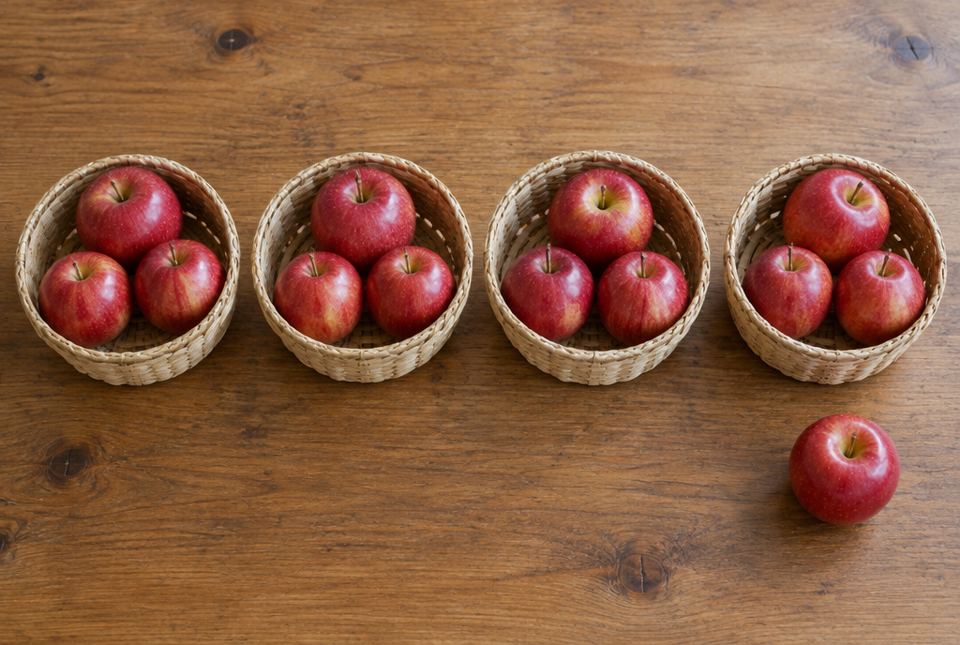 13 apples shared into 4 equal groups: 3 in each basket and 1 left over. 13 ÷ 4 = 3 R1. AI-generated image
🍎🍎🍎🍎🍎🍎🍎🍎🍎🍎🍎🍎🍎
13 apples: 4 groups of 3, and 1 apple left over.Finding the remainder
- Find how many equal groups you can make.
- Multiply to see how many you used.
- Subtract to find what's left. That's the remainder.
The remainder must be smaller than the divisor. If it isn't, you can make another group!
Worked exampleExample 1: A remainder with a fact
- Think: which 5s fact is close to 47 without going over? 5 × 9 = 45.
- 47 − 45 = 2 left over.
- 2 is smaller than 5, so we're done.
47 ÷ 5 = 9 R2. Check: 5 × 9 + 2 = 45 + 2 = 47. ✓
Worked exampleExample 2: Partial quotients with a remainder
- Take away 20 groups of 6 = 120. 158 − 120 = 38 left.
- Take away 6 groups of 6 = 36. 38 − 36 = 2 left.
- 2 is smaller than 6, so it's the remainder.
- Groups: 20 + 6 = 26.
158 ÷ 6 = 26 R2. Check: 6 × 26 + 2 = 156 + 2 = 158. ✓
What should we do with the remainder?
In a story, the remainder can mean different things. Read the question carefully and ask: What makes sense?
- Leave it as left over. 26 stickers shared by 4 friends: 6 each, and 2 stickers left over.
- Round up. 26 children go canoeing, 4 in each canoe: 26 ÷ 4 = 6 R2. The 2 extra children need a canoe too, so you need 7 canoes.
- Drop it. You have $26 and books cost $4 each: 26 ÷ 4 = 6 R2. You can buy 6 books. The $2 left isn't enough for another book.
- Share it as a fraction. If the leftover can be cut into equal pieces, like food or a ribbon, share it!
Sharing the remainder as a fraction
Five granola bars are shared equally by 4 children. Each child gets 1 whole bar. One bar is left. Cut it into 4 equal pieces, and each child gets 1/4 more.
Each child gets 1 and 1/4 bars. We write 1 1/4.
5 ÷ 4 = 1 R1, and the remainder 1 shared among 4 is 1/4. So 5 ÷ 4 = 1 1/4.
A quick way: the remainder goes on top of the fraction, and the divisor goes on the bottom.
- 7 ÷ 2 = 3 R1 → 3 1/2
- 13 ÷ 4 = 3 R1 → 3 1/4
- 11 ÷ 3 = 3 R2 → 3 2/3
Worked exampleExample 3: Pizza night
7 pizzas are shared equally by 2 families. How much pizza does each family get?
- 7 ÷ 2 = 3 R1. Each family gets 3 whole pizzas.
- 1 pizza is left. Cut it in half. Each family gets 1/2 more.
Each family gets 3 1/2 pizzas.
Worked exampleExample 4: Round up
A van holds 8 people. 50 people are going to a hockey tournament. How many vans do they need?
- 50 ÷ 8: 8 × 6 = 48. 50 − 48 = 2. So 50 ÷ 8 = 6 R2.
- 6 vans carry 48 people. The 2 extra people still need a ride.
- Round up to 7 vans.
Does my answer make sense?
After you divide, read the question again. Ask: "Does everyone need a spot? Can the leftover be cut up? Or is the leftover just extra?" Thinking about what makes sense is a big part of being a mathematician.
Just for funRiddle: 13 cookies are shared by 4 friends, and each gets 3. Who gets the last cookie?
Answer: The remainder! (Or cut it into 4 equal pieces so everyone gets one more bite.)
Hands-on activityLeftover snack share
You need: 23 small crackers or pieces of cereal (keep small foods away from little children), 4 small plates, and 3 paper squares to cut (ask a grown-up for scissors).
- Share the 23 crackers equally among 4 plates, one at a time.
- How many on each plate? How many are left over? Write it: 23 ÷ 4 = 5 R3.
- Now pretend the 3 leftovers are paper squares (they're easier to cut). Cut each paper square into 4 equal pieces, and give each plate 1 piece from each square.
- Each plate now has 5 whole crackers and 3 fourths: 5 3/4.
- Talk: when would you leave the remainder as left over? When would you cut it?
Your turn
3 R2. 5 × 3 = 15, and 17 − 15 = 2.
9 R2. 3 × 9 = 27, and 29 − 27 = 2.
7 R1. 7 × 7 = 49, and 50 − 49 = 1.
21 R1. 4 × 20 = 80, 5 left. 4 × 1 = 4, 1 left. 20 + 1 = 21, remainder 1.
532 children sit at tables of 6. How many tables are needed?
6 tables. 32 ÷ 6 = 5 R2. The 2 extra children need a table too, so round up.
63 sandwiches are shared equally by 2 children. How much does each child get?
1 1/2 sandwiches. 3 ÷ 2 = 1 R1. Cut the leftover sandwich in half.
7You have $45. Books cost $8 each. How many books can you buy?
5 books. 45 ÷ 8 = 5 R5. The $5 left over isn't enough for another book.
More practice: on your own
24 R2. 3 × 20 = 60, 14 left. 3 × 4 = 12, 2 left. Check: 3 × 24 + 2 = 74.
31 R1. 4 × 30 = 120, 5 left. 4 × 1 = 4, 1 left. Check: 4 × 31 + 1 = 125.
39 pizzas are shared equally by 4 families. How much does each family get?
2 1/4 pizzas. 9 ÷ 4 = 2 R1. Cut the last pizza into 4 equal pieces: each family gets 1/4 more.
4A canoe holds 3 people. 20 campers go canoeing. How many canoes do they need?
7 canoes. 20 ÷ 3 = 6 R2. The 2 extra campers need a canoe, so round up.
5A 100 cm ribbon is cut into pieces that are 7 cm long. How many full pieces?
14 pieces. 100 ÷ 7 = 14 R2 (7 × 14 = 98). The 2 cm left is too short for another piece.
Challenge
1437 ÷ 6 = ? Check your answer.
72 R5. 6 × 70 = 420, 17 left. 6 × 2 = 12, 5 left. Check: 6 × 72 + 5 = 432 + 5 = 437. ✓
2A 10 m rope is cut into 4 equal pieces. How long is each piece?
2 2/4 m, which is the same as 2 1/2 m. 10 ÷ 4 = 2 R2. The 2 leftover metres shared by 4 gives 2/4 of a metre each.
3Find a number between 20 and 30 that has a remainder of 3 when you divide it by 5.
23 or 28. 23 ÷ 5 = 4 R3 and 28 ÷ 5 = 5 R3.
Quiz
2. 27 people go to a game. Each car holds 4 people. How many cars are needed?
3. When you divide by 4, which remainder is impossible?
4. 5 cookies are shared equally by 2 children. How much does each child get?
5. You have $30. Puzzles cost $7 each. How many puzzles can you buy?
Big idea: The curriculum (B2.6) asks Grade 4 students to divide 2- or 3-digit numbers by 1-digit numbers and to express a remainder as a fraction when appropriate. The real skill is interpreting the remainder in context: leave it, round up, drop it, or share it as a fraction.
Common difficulties:
- A remainder bigger than the divisor (17 ÷ 5 = 2 R7). Ask: "Can you make another group?"
- Always rounding up, or never rounding up. Act out the story: "If 2 kids don't get a canoe, are they left on the dock?"
- Writing the fraction upside down (5 ÷ 4 = 1 4/1). The remainder is shared among the divisor: 1 shared among 4 is 1/4.
How to help: Use real sharing moments: pizza slices, cookies, cars for a team outing. Ask "What do we do with the leftovers?"