B. Foundations of Language · Listening, Speaking and Word PowerListening in Groups: Asking for More and Building on Ideas
B1.1 B1.2 A1About 40 minutes
Learning goals- I can ask questions that encourage a speaker to tell me more.
- I can respond to what others say in a group discussion by building on, agreeing or politely disagreeing.
- I can choose listening strategies to use before, during and after listening.
- I can show interest at the right times and ask for clarification when I need it.
- I can plan a good response to what I heard.
Words to know
elaborate
To give more details or explain an idea more fully.
discussion
A conversation where a group shares and talks about ideas.
build on
To add your own idea to someone else's idea.
clarification
An explanation that makes something clear. You seek clarification when you ask about something you did not understand.
respond
To answer or react to what someone said.
active listener
A person who listens with their mind and body, thinks about the message, and shows they are paying attention.
Remember from Grade 3
In Grade 3 you learned to ask clarifying questions ("What does webbing mean?"), to use listening strategies before, during and after listening, and to summarize the big ideas. In Grade 4 you will do more in group discussions: you will help speakers say more, and you will build on what other people say.
Let's start with a story
Four Grade 4 students are planning a class garden. Amira says, "We should plant sunflowers."
- Ben says, "Okay." Then he talks about hockey.
- Lucas says, "Why sunflowers?"
- Mei says, "I like Amira's idea, and we could save the seeds for the birds in the fall."
Lucas asked a question that helps Amira elaborate (say more). Mei built on Amira's idea. Ben's answer stopped the conversation. Lucas and Mei were active listeners.
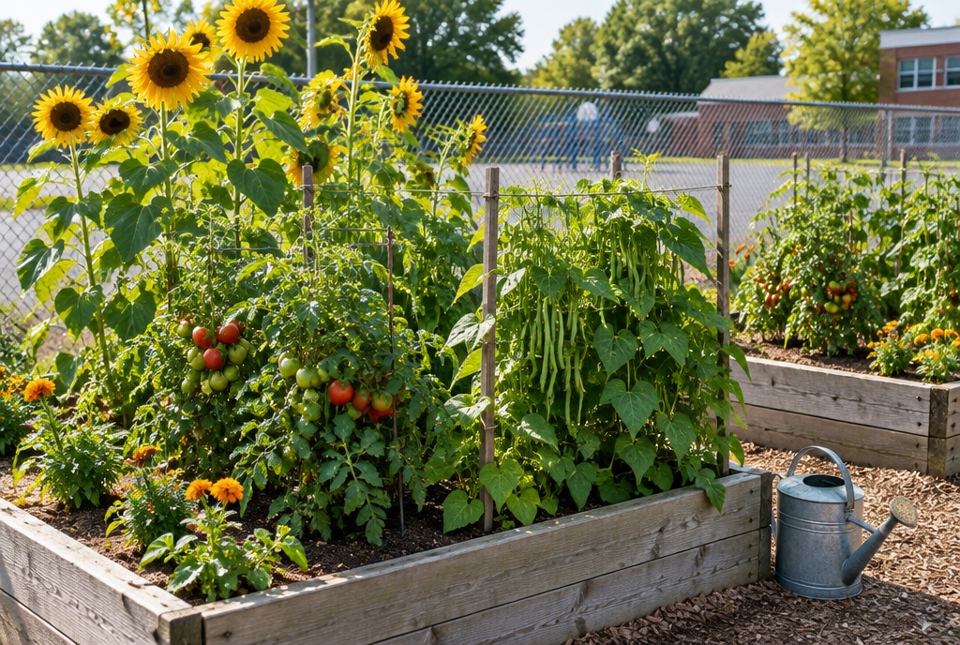 A class garden with sunflowers, like the one Amira suggested. Questions such as "Why sunflowers?" help a speaker say more about an idea. AI-generated imageThe garden discussion as a chain. Lucas's question and Mei's idea keep it going; Ben's answer breaks the chain.
Questions that help a speaker say more
Sometimes a speaker gives a short answer. A good listener asks an open question that invites more details. Open questions can't be answered with just yes or no.
| Question starter | What it asks for |
|---|
| "Can you tell us more about ___?" | More details |
| "Why do you think that?" | Reasons |
| "Can you give an example?" | An example that shows the idea |
| "What happened next?" | The rest of a story or event |
| "How did you figure that out?" | Their thinking steps |
| "What would happen if ___?" | New ideas or predictions |
Worked exampleLet's ask a question to help someone say more
In a book talk, Jacob says: "I liked the book. It was good."
What could you ask so Jacob elaborates?
- Jacob's answer is very short. We don't know why he liked it.
- A yes/no question like "Was it good?" would not help. He already said yes!
- Ask an open question: "What part did you like best, and why?"
- Jacob answers: "The part where the girl finds her way home in the blizzard. It was so exciting, I couldn't stop reading." Now we learn much more.
"What part did you like best, and why?" is an open question that invites Jacob to give details and reasons.
A closed question gets a one-word answer. An open question invites details and reasons.Responding to others in a group
In a group discussion, everyone's ideas connect like links in a chain. When you respond, connect to what the last person said before adding your own idea.
| To... | You can say... |
|---|
| Agree and add | "I agree with Mei, and I'd add that..." |
| Build on | "Going back to what Amira said about sunflowers..." |
| Disagree politely | "I see it differently because..." or "That's a good point, but what about...?" |
| Connect | "That reminds me of..." |
| Invite someone in | "Ravi, we haven't heard your idea yet. What do you think?" |
Disagree with the idea, not the person
It's okay to disagree in a discussion! Good thinkers often do. Talk about the idea ("I'm not sure sunflowers will grow in the shade"), not the person ("That's a dumb idea"). Keep your voice calm and give a reason.
Listening strategies: before, during and after
You learned these in Grade 3. In Grade 4, you choose the ones that fit the job.
| When | Strategies to choose from |
|---|
| Before | Think about the topic and what you already know. Set a purpose: Why am I listening? What do I want to find out? |
| During | Picture it in your mind. Listen for signal words (first, because, however, the most important). Watch the speaker's face and hands. Jot a word or two if it's a long talk. Notice when you are confused. |
| After | Summarize the main ideas. Ask clarifying questions. Connect to what you know. Plan your response. |
Showing interest at the right times
Active listeners show they are paying attention without interrupting:
- Nod, or show interest on your face.
- Say a short word like "Mm-hmm" or "Wow!" at a natural pause.
- Wait until the speaker finishes a thought before you ask your question.
Listening can look different for different people. In some families and cultures, looking down or away while someone talks is a way to show respect. Some people listen best while doodling or holding something quietly. What matters is that you are thinking about the message.
Sharing circles
Many First Nations communities, and many classrooms, use sharing circles (also called talking circles). People sit in a circle and take turns speaking, often while holding an object such as a stone or a feather. Everyone else listens without interrupting until it is their turn. It is a powerful way to make sure every voice is heard.
Worked exampleLet's plan a response
A guest speaker from the local fire station says: "Every home should have a working smoke alarm on every floor. Test it once a month by pressing the button. If it beeps, it works."
Plan a good response.
- Summarize in your head: smoke alarms on every floor; test monthly with the button.
- Notice anything confusing: What if it doesn't beep?
- Ask to clarify: "What should we do if the alarm doesn't beep when we test it?"
- Connect and share: "We have one in our hallway. I'm going to ask my family to test it this weekend."
A good response shows you understood, asks about what was unclear, and connects the message to your own life.
Just for funWhy are rabbits such good listeners?
Because they're all ears!
Hands-on activitySupper-table discussion
You need: your family or a few people at home, and a question everyone can talk about, such as "What is the best season in Canada, and why?" or "Should kids have homework?"
- Before: Each person thinks quietly for 30 seconds about what they know and think.
- Take turns sharing. You can pass around a spoon or a small stone to show whose turn it is.
- During: When someone finishes, the next speaker must start by connecting: "I agree with ___ because...", "I see it differently because..." or "Building on what ___ said..."
- Each person asks one open question to help someone else say more, like "Can you give an example?"
- After: Each person summarizes one idea that someone else shared.
Talk about it: Which question got the longest, most interesting answer? Why?
Your turn
1Which question helps a speaker elaborate: "Did you like the trip?" or "What was the most surprising thing you saw on the trip?" Why?
"What was the most surprising thing you saw on the trip?" It is an open question. It can't be answered with just yes or no, so the speaker has to give details.
2Your friend says, "I think our class should have a pet." Write a question that asks for a reason.
Example: "Why do you think a class pet would be a good idea?" (Any question asking why works.)
3Finish this response so it builds on an idea: Sam said, "We could collect cans for the food bank." You say: "Building on Sam's idea, ..."
Example: "Building on Sam's idea, we could make posters so the whole school knows about it." (Look for an idea that adds to Sam's, not a new topic.)
4Rewrite this rude response to be a polite disagreement: "That's wrong. Winter is boring."
Example: "I see it differently. I think winter is fun because we can skate and build snow forts." It talks about the idea and gives a reason.
5Name one listening strategy to use before a talk about bees.
Any one: think about what you already know about bees; set a purpose, like "I want to find out how bees make honey"; predict what the talk will be about.
6You missed what the speaker said because a truck drove by. What could you say after the speaker finishes?
"Sorry, I missed the part about ___. Could you say it again, please?" This is seeking clarification politely.
7Name two ways to show interest without interrupting.
Any two: nod; show interest on your face; say "Mm-hmm" or "Wow" at a pause; lean in a little; wait to ask your question at the end.
More practice: warm-up
1What does elaborate mean?
To give more details or explain more.
2Is "Do you like pizza?" an open question or a yes/no question?
3Finish the starter: "I agree with Leila because..."
Any reason that fits, for example "I agree with Leila because recess is a good time to get exercise."
4What is one thing you do after listening?
Any one: summarize the main ideas; ask a clarifying question; connect to what you know; plan a response.
5In a sharing circle, what do the other people do while one person speaks?
They listen without interrupting until it is their turn.
More practice: on your own
1Turn this yes/no question into an open question: "Was the hockey game exciting?"
Example: "What was the most exciting part of the hockey game?" or "How did the game end?" Open questions ask what, why or how.
2Ravi hasn't said anything in your group yet. What could you say to invite him in?
Example: "Ravi, what do you think?" or "Ravi, do you have an idea to add?" Inviting others makes sure every voice is heard.
3A speaker says, "Maple syrup comes from sap." You don't know the word sap. Write a clarifying question.
"What is sap?" or "What do you mean by sap?" It asks the speaker to explain a word they used. (Sap is the watery liquid inside a tree.)
4Why is it a good idea to connect to what the last speaker said before giving your own idea?
It shows you listened, it keeps the discussion on topic, and it helps the ideas build on each other instead of jumping around.
5Your classmate looks down at the floor while you talk, but then repeats your idea perfectly. Was your classmate listening? Explain.
Yes. Repeating your idea shows they understood. Listening can look different for different people; in some families and cultures, looking down shows respect.
Challenge
1Write a short group discussion (3 speakers) about "Should our school have a longer recess in winter?" Each speaker must connect to the speaker before.
Example:
- Aiden: "I think we should, because kids need to burn off energy."
- Priya: "I agree with Aiden, and I'd add that fresh air helps us focus."
- Noah: "Those are good points, but what about really cold days? Maybe longer recess only when it's above minus 15."
Look for: each speaker uses a connecting starter and adds a new idea or a polite disagreement with a reason.
2A guest says: "Wetlands are like sponges. They soak up water during floods." Write (a) one question that asks her to elaborate and (b) one question that seeks clarification.
(a) Elaborate: "Can you give an example of a time a wetland helped stop a flood?" or "What else do wetlands do?"
(b) Clarify: "What do you mean when you say wetlands are like sponges?" or "What is a wetland?"
An elaborate question asks for more; a clarifying question asks about something already said that was unclear.
3Your group is stuck because two people keep arguing. Using what you learned, what could you say to help the discussion move forward?
Example: "Let's hear the reasons for both ideas, then decide. Ji-woo, can you tell us why you like your plan? Then Marc can share his." Look for: staying calm, focusing on ideas, inviting reasons, and making sure each person is heard.
Quiz
1. Which question best helps a speaker elaborate?
2. Ella says, "We could plant a tree." Which response builds on her idea?
3. Which is the most respectful way to disagree?
4. Which is a strategy for before listening?
5. When is the best time to say "Wow!" to show interest?
6. A speaker uses a word you don't know. What should you do?
Big idea: In Grade 4 (B1.1, B1.2), students use effective listening skills in group discussions: asking questions that encourage a speaker to elaborate, responding to others' contributions, choosing listening strategies, showing interest at appropriate times, and seeking clarification. These skills also support Strand A1 (communication and collaboration).
How to help at home:
- Have short family discussions at meals or in the car. Model starters like "I agree with you, and..." or "Why do you think that?"
- When your child gives a one-word answer about their day, model an open question: "What was the funniest thing that happened?"
- Notice and praise when your child builds on someone's idea or asks for an example.
Common difficulties:
- Asking yes/no questions. Practise turning them into what, why or how questions.
- Waiting to talk instead of listening. Ask your child to summarize the last speaker's idea before adding their own.
- Disagreeing bluntly. Practise "I see it differently because...".
Note: Listening behaviours vary across families and cultures (for example, eye contact). Focus on whether your child understood and responded thoughtfully, not on one way of looking attentive.