B. Number · Operations: Adding and Subtracting to 1000, Multiplying and DividingDivision: Sharing, Grouping and Fact Families
B2.6 B2.1About 40 minutes
Learning goals- I can use the ÷ sign to write a division sentence.
- I can divide by sharing equally and by making equal groups.
- I can show division with arrays and a number line, up to 100 ÷ 10.
- I can use a multiplication fact to divide, and check division by multiplying.
Words to know
divide
Split a total into equal groups. 12 ÷ 3 means 12 split into 3 equal groups, or 12 split into groups of 3.
÷
The division sign. Say "divided by".
quotient
The answer when you divide. In 12 ÷ 3 = 4, the quotient is 4.
sharing
Dealing out a total into a number of groups to find how many are in each group.
grouping
Making groups of a certain size to find how many groups there are.
fact family
Multiplication and division facts that use the same three numbers, like 3 × 4 = 12 and 12 ÷ 4 = 3.
Remember from Grade 2
In Grade 2 you shared up to 12 things equally, like 12 muffins among 3 friends (4 each). You also made teams, like 10 kids in teams of 2 (5 teams). In Grade 3 you will divide bigger numbers, up to 100 ÷ 10, and you will use the ÷ sign.
Let's start with a story
15 strawberries are shared equally among 3 kids. How many does each kid get?
Deal them out one at a time: one for you, one for you, one for you... until they are all gone. Each kid gets 5.
We write: 15 ÷ 3 = 5. Say: "15 divided by 3 equals 5."
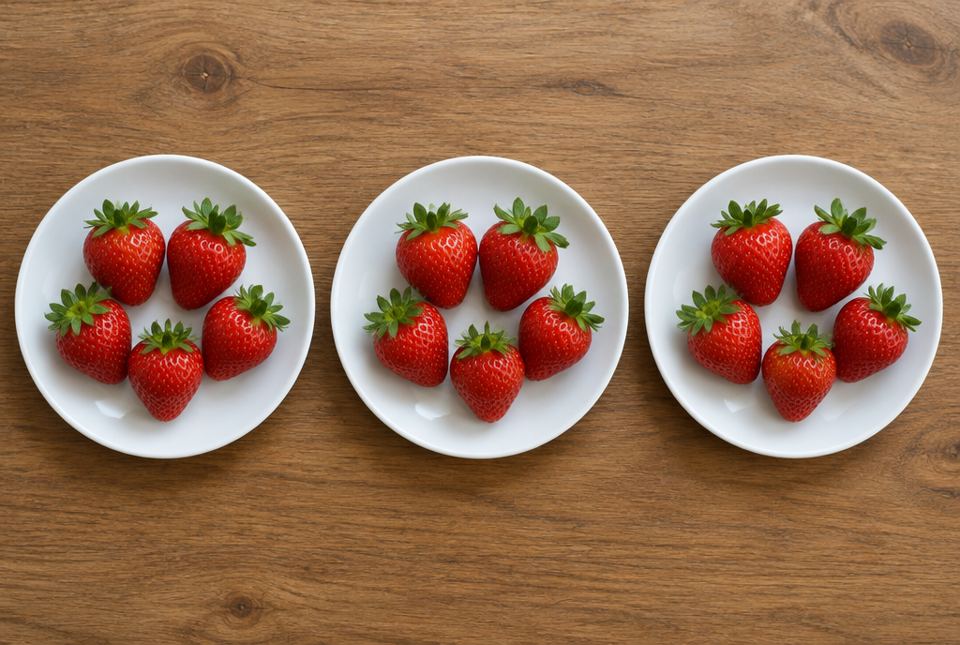 15 strawberries shared equally on 3 plates: each plate has 5. That is 15 ÷ 3 = 5. AI-generated image
🍓🍓🍓🍓🍓🍓🍓🍓🍓🍓🍓🍓🍓🍓🍓
15 strawberries shared into 3 equal groups: 5 in each group. 15 ÷ 3 = 5.Two kinds of division
Division can answer two different questions.
- Sharing: You know the number of groups. How many go in each group? 15 strawberries shared among 3 kids: how many each? 15 ÷ 3 = 5 each.
- Grouping: You know how many go in each group. How many groups can you make? 24 students in teams of 6: how many teams? 24 ÷ 6 = 4 teams.
Both are division.
Worked exampleExample 1: Grouping
24 students make teams of 6. How many teams?
- We know the size of each team (6). We need the number of teams.
- Make groups of 6: 6, 12, 18, 24. That is 4 groups.
- Write: 24 ÷ 6 = 4.
24 students in teams of 6 makes 4 teams. 24 ÷ 6 = 4.Division with an array
An array helps too. 18 chairs are set up in 3 equal rows. How many chairs are in each row?
Make 3 rows and keep adding one chair to each row until you use all 18. Each row has 6. So 18 ÷ 3 = 6.
Division on a number line
To solve 40 ÷ 10, start at 40 and jump back by 10 until you reach 0. Count the jumps: 4 jumps. So 40 ÷ 10 = 4.
Multiplication and division are partners
Look at the 18 chairs again. 3 rows of 6 is 3 × 6 = 18. And 18 shared into 3 rows is 18 ÷ 3 = 6. Multiplication and division undo each other.
The same three numbers make a fact family:
- 3 × 6 = 18
- 6 × 3 = 18
- 18 ÷ 3 = 6
- 18 ÷ 6 = 3
In a division fact, the biggest number (the product) always comes first.
Worked exampleExample 2: Think multiplication to divide
- Ask: "5 times what makes 35?"
- Count by 5s: 5, 10, 15, 20, 25, 30, 35. That is 7 fives.
- So 5 × 7 = 35.
Worked exampleExample 3: Check by multiplying
Ava says 48 ÷ 6 = 8. Is she right?
- To check division, multiply the answer by the number you divided by.
- 8 × 6: 6 × 8 is the same. Count by 8s six times: 8, 16, 24, 32, 40, 48.
- We got back to 48.
Yes, Ava is right. 6 × 8 = 48, so 48 ÷ 6 = 8.
Worked exampleExample 4: Find the missing number
- Ask: "4 times what makes 28?" This is the same as 28 ÷ 4.
- Count by 4s: 4, 8, 12, 16, 20, 24, 28. That is 7 fours.
□ = 7, because 4 × 7 = 28 and 28 ÷ 4 = 7.
Division order matters
In multiplication you can switch the factors: 3 × 6 = 6 × 3. In division you cannot switch the numbers. 18 ÷ 3 (18 shared by 3) is 6, but 3 ÷ 18 would be 3 cookies shared by 18 kids, which is a very different question! Always start with the total.
Just for funWhat did the ÷ sign say to the × sign?
"Let's stick together. We're family!"
Hands-on activitySnack-time division
You need: a handful of small snacks or counters (crackers, cereal pieces or dried pasta), and a few small plates or cups. Little ones nearby? Keep small pieces away from babies and toddlers.
- Count out 24 pieces.
- Sharing: Share them equally onto 4 plates, dealing one at a time. How many on each plate? Write: 24 ÷ 4 = 6.
- Grouping: Put them all back. Now put 3 on each plate until they are all used. How many plates did you need? Write: 24 ÷ 3 = 8.
- Write the fact family for 3, 8 and 24.
- Try other totals: 20, 30 and 36. Can you share each one into equal groups with none left over?
Math talk: "Which time did you know the number of groups, and which time did you know the size of the group?"
Your turn
4. Count by 5s: 5, 10, 15, 20. That is 4 fives.
330 crayons are shared equally among 3 kids. How many does each kid get?
10 crayons. 30 ÷ 3 = 10, because 3 × 10 = 30.
416 kids get into pairs. How many pairs? Write the division sentence.
5Write the fact family for 3, 8 and 24.
3 × 8 = 24, 8 × 3 = 24, 24 ÷ 3 = 8, 24 ÷ 8 = 3.
6Find the missing number: 6 × □ = 36
More practice: warm-up
56 cookies are shared equally among 6 kids. How many each?
1 cookie each. 6 ÷ 6 = 1.
More practice: on your own
2A coach has 27 pucks. She puts 9 in each bucket. How many buckets does she fill?
3 buckets. 27 ÷ 9 = 3, because 9 × 3 = 27. (This is grouping.)
8. 4 × 8 = 32. (Count by 4s: 4, 8, 12, 16, 20, 24, 28, 32.)
4Mia says 45 ÷ 5 = 8. Check by multiplying. What is the right answer?
5 × 8 = 40, not 45, so Mia is wrong. 5 × 9 = 45, so 45 ÷ 5 = 9.
Challenge
160 ÷ 10 = 6. What is 60 ÷ 6? How do you know without counting?
10. 6 × 10 = 60, and 60 ÷ 10 = 6 is in the same fact family, so 60 ÷ 6 = 10.
236 kids need to make teams of the same size. List all the ways to make 2, 3, 4, 6 or 9 teams. How many kids are on each team?
2 teams of 18, 3 teams of 12, 4 teams of 9, 6 teams of 6, 9 teams of 4. Each one multiplies to 36.
325 apples are shared equally among 4 kids. How many does each kid get? Are any left over?
6 apples each, with 1 left over. 4 × 6 = 24, and 25 − 24 = 1.
Quiz
2. Which fact helps you solve 40 ÷ 8?
3. 24 kids make teams of 4. How many teams?
4. How can you check that 63 ÷ 9 = 7?
6. Which is not in the fact family of 4, 6 and 24?
Big idea: Grade 3 students represent division up to 100 ÷ 10 using tools and drawings, including arrays (B2.6), and use the relationship between multiplication and division to solve problems and check calculations (B2.1). The ÷ sign is new in Grade 3.
Common difficulties:
- Mixing up sharing and grouping. Both are division. Ask: "Do we know how many groups, or how many in each group?"
- Dealing unequally. When sharing, deal one at a time and check that every group has the same amount.
- Writing division backwards (3 ÷ 18). Remind your child that the total comes first.
- Not using multiplication. Children often count everything. Encourage: "What times 5 makes 35?"
How to help: Divide in real life: sharing grapes, setting up teams, putting cookies on plates. Say the sentence together: "20 divided by 4 is 5, because 4 times 5 is 20." Leftovers (remainders) are fine to talk about, but Grade 3 focuses on division with no remainders.