B. Drama / D. Visual Arts · Drama and Visual ArtsDrama: Setting, Tension and the Big Idea
B1.1 B1.2 B1.3 B2.2About 35 minutes
Learning goals- I can create a pretend place and time (a setting) and act as if I am really there.
- I can build tension with a mystery or a problem to solve.
- I can tell the main idea of a drama.
- I can explore stories from many communities, times and places through drama.
Words to know
setting
Where and when a story happens. In drama this is called time and place.
tension
The feeling of "What will happen next?" when there is a mystery or a problem to solve.
main idea
What a drama or story is mostly about. It is sometimes called the central theme or the big idea.
theme
A big idea or lesson in a story, like sharing, being brave or caring for the earth.
folk tale
A story told for a very long time in a community, passed from person to person.
Where are we? When are we?
Close your eyes. You are standing on a frozen lake in January. The wind is cold. Your boots crunch on the snow.
Now open your eyes and show it. Are you shivering? Hugging yourself? Stepping carefully on the slippery ice?
You just created a setting!
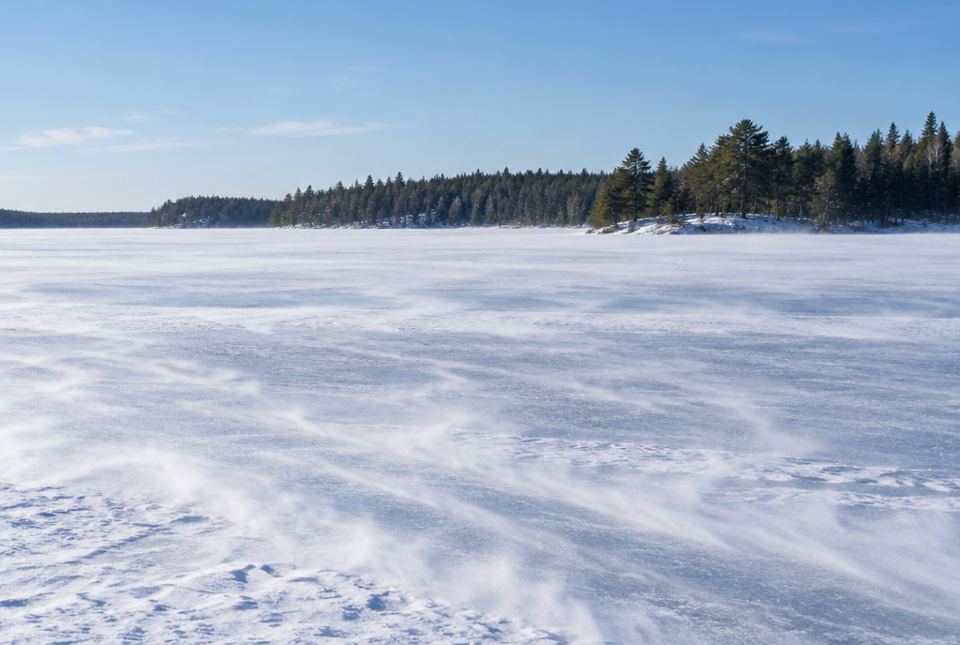 A frozen lake in January, with the wind blowing snow across the ice. How would you show this setting with your body: shivering, hugging yourself, stepping carefully? AI-generated image
Time and place
The setting is where and when a drama happens.
- Where: a forest, a city bus, a castle, the Arctic, your kitchen
- When: long ago, today, in the future, at night, in winter
You don't need scenery. You make the setting real by how you act. In a hot desert you wipe sweat from your face. In a tent at night you whisper so you don't wake anyone.
| Setting | How you can show it with your body and voice |
|---|
| a frozen lake in winter | shiver, rub your hands, slide carefully |
| a cottage dock in summer | swat mosquitoes, dip your toes in the water, squint in the sun |
| a busy city sidewalk | look up at tall buildings, step around people, talk loudly over the noise |
| a quiet library | tiptoe, whisper, turn pages gently |
| a village long ago | no phones or cars! Carry water in a bucket, walk everywhere |
Tension: What will happen next?
Tension is the feeling that makes the audience lean forward and wonder, "What will happen next?"
Tension comes from a mystery or a problem to solve:
- a strange noise outside the tent
- a lost puppy in a snowstorm
- a door that is locked, and the key is missing
You can make tension stronger with a pause, a whisper, slow movements or a sudden sound.
The big idea
Every good story or drama is mostly about something. This is its main idea or theme.
Ask: "What is this drama really about? What does it teach?"
- The Tortoise and the Hare: slow and steady can win the race.
- Stone Soup: when everyone shares a little, there is enough for all.
When actors know the main idea, they can focus on the most important moments.
Stories from many communities
Drama can help us explore stories from many places and times:
- Stone Soup: a folk tale told in many European countries, in many versions
- The Lion and the Mouse: a fable from ancient Greece. A tiny mouse saves a mighty lion.
- Anansi stories: from West Africa and the Caribbean, about a clever spider
- The Water Walker by Joanne Robertson, an Anishinaabe author: a true picture-book story about Nokomis (Grandmother) Josephine Mandamin, who walked around the Great Lakes carrying a copper pail of water to show that water is precious and must be protected.
Stories from First Nations, Métis and Inuit communities
Many First Nations, Métis and Inuit stories are shared by Elders and storytellers, and some have rules about who may tell them and when (some are told only in winter). Choose books written by Indigenous authors, name the author and Nation, and act out the ideas (like caring for water) with respect rather than copying sacred stories or ceremonies.
Worked exampleExample: Stone Soup as a drama
Let's plan a short drama of Stone Soup with the family.
- Time and place: a small village, long ago, on a cold evening. We show the cold by rubbing our hands and shivering.
- Characters: a hungry traveller and some villagers who are worried there isn't enough food.
- Tension (the problem): The traveller is hungry, but the villagers say, "We have nothing to share!" Will anyone help?
- What happens: The traveller puts a stone in a pot of water. "Stone soup! It would be even better with a carrot..." One by one, the villagers bring a carrot, an onion, some potatoes.
- End: Everyone eats a delicious soup together. The tension is gone.
- Main idea (focus): When everyone shares a little, there is enough for all.
We created a setting (a cold village long ago), built tension (will anyone share?), and kept our focus on the main idea: sharing.
Worked exampleExample: Building tension with a mystery
You are camping. It is night. Let's make the audience feel tension.
- Setting: lie down in a pretend tent. Yawn and whisper, "Good night."
- Mystery: a grown-up makes a sound: crunch... crunch...
- Pause. Sit up slowly. Eyes wide. Whisper: "Did you hear that?"
- Move slowly to the tent door... unzip it very slowly...
- Surprise ending: it's a raccoon looking for snacks! Everyone laughs. The tension is over.
The pause, whispers and slow movements built tension. Solving the mystery (a raccoon!) ended it.
Just for funReal raccoons have clever front paws that can open latches and lift lids. No wonder a raccoon is the perfect "mystery guest" in a camping drama!
Hands-on activityBlanket fort setting and a mystery
You need: a blanket, chairs or cushions, a flashlight, and something that makes a sound (a spoon and a pot, crinkly paper).
- Build a fort. Decide together where and when it is: a cave long ago? A spaceship in the future? An igloo in a snowstorm?
- Go in role and show the setting with your body and voice.
- A grown-up makes a mystery sound. Build tension: pause, whisper, move slowly.
- Solve the mystery together. Build on each other's ideas!
- Come out of role and tell: "What was our drama mostly about?" (the main idea)
Your turn
1What two things does a setting tell us?
Where and when the story happens (time and place).
2Show that you are at a beach on a hot summer day without saying where you are.
Look for: wiping sweat, squinting at the sun, walking on hot sand (hopping), swimming motions or putting on sunscreen.
3What is tension in a drama?
The feeling of "What will happen next?" that comes from a mystery or a problem to solve.
4Name two ways an actor can make tension stronger.
Any two: a pause, a whisper, slow movements, a sudden sound, a worried face.
5What is the main idea of The Lion and the Mouse?
Even someone small can help someone big; be kind to everyone, because friends can come in all sizes.
6In The Water Walker, what was Nokomis Josephine Mandamin's big idea?
That water is precious and we need to protect it.
7Is "a lost mitten in a snowstorm" a setting, a problem, or both?
Both. The snowstorm is the setting, and the lost mitten is a problem that creates tension.
More practice: warm-up
1Where might a story about a polar bear take place?
In the Arctic, on snow and sea ice.
2Show you are in a quiet library.
Look for: tiptoeing, whispering, turning pages gently.
3True or false: Tension makes the audience wonder what will happen next.
4What does main idea mean?
What a story or drama is mostly about.
5Name a story from another country or community.
Examples: Stone Soup (Europe), The Lion and the Mouse (ancient Greece), Anansi stories (West Africa and the Caribbean), The Mitten (Ukraine).
More practice: on your own
1Act out walking through a forest at night so your audience can tell the time and place. What did you do?
Example: walk slowly, look around, jump at small sounds, hold a pretend flashlight, step over roots. These show night (dark) and forest (trees, roots).
2Make up a problem for a drama set at a winter carnival.
Examples: the ice sculpture starts to melt; a child gets lost in the crowd; the sled team's dog runs away. Any problem that creates tension is fine.
3What is the main idea of Stone Soup? Explain.
Sharing: when everyone gives a little, there is enough for everyone. The villagers each added food and they all ate together.
4How is a drama long ago different from a drama today? Give one example.
Example: long ago there were no phones or cars, so characters might walk to visit, carry water, or cook over a fire. Today they might text or drive.
5A drama is getting boring. How could you add tension?
Add a mystery or problem: a strange knock at the door, a missing key, a storm coming. Use a pause or whisper to build it.
Challenge
1Plan a short drama inspired by The Water Walker. Give a setting, a problem, and the main idea.
Example: Setting – a lakeshore in the morning today. Problem – there is garbage in the water and the fish are in trouble. Main idea – water is precious, so we work together to protect it (pick up litter, tell others). Look for all three parts.
2Why does tension go down at the end of most stories?
Because the problem is solved or the mystery is answered, so the audience no longer wonders what will happen.
3Two families act The Tortoise and the Hare. One sets it in a forest; the other sets it on a city sidewalk. Would the main idea change? Explain.
No. The setting changes how it looks and how actors move, but the main idea (slow and steady can win; don't show off) stays the same.
Quiz
1. The setting of a drama tells ___.
3. The main idea of Stone Soup is ___.
4. An actor shivers and rubs their hands. What setting are they probably showing?
5. How can an actor build tension?
6. The Water Walker is written by Joanne Robertson. Who is she?
7. What usually happens to the tension at the end of a story?
Big idea: This lesson covers three Grade 2 elements of drama: time and place (establishing a fictional setting and relating to it in role), tension (a sense of mystery or a problem to be solved), and focus and emphasis (identifying the main idea or central theme). Children explore stories from diverse communities, times and places (B1.1).
How to help:
- After a story, ask "What was it mostly about?" and "When did you feel most worried or excited?"
- Play "Where am I?": act out a place silently and let your child guess, then switch.
- Read folk tales and books by authors from many cultures, including First Nations, Métis and Inuit authors such as Joanne Robertson (The Water Walker).
Respect note: Some Indigenous stories are sacred or belong to particular families or Nations and have rules about when they are told. Picture books written by Indigenous authors and published for children are a good, respectful starting point.
Common difficulties:
- Main idea vs. retelling. If your child retells the whole plot, ask: "In one sentence, what did it teach?"
- Tension becomes too scary. Keep a friendly ending (the raccoon!) and use "Freeze! Back to me!"