D. Structures and Mechanisms · Simple Machines and MovementLevers: Lifting with a Bar
D2.3 D2.4 D2.5 A1.2 A1.4About 35 minutes
Learning goals- I can name the parts of a lever: the bar, the fulcrum, the load and the effort.
- I can find levers in daily life, like a seesaw, a bottle opener and a shovel.
- I can test how moving the fulcrum changes how hard I have to push.
Words to know
lever
A stiff bar that turns (pivots) on a point to help lift or move a load.
fulcrum
The point that a lever turns on. On a seesaw, it is the middle part that holds it up.
load
The thing the lever lifts or moves.
effort
The push or pull you put on the lever.
pivot
To turn on a point.
Seesaw puzzle
A grown-up and a Grade 2 kid get on a seesaw. The grown-up is much heavier. The grown-up's side goes down, and the kid is stuck up in the air!
How can they make it balance? The grown-up can slide closer to the middle. Then the kid can lift the grown-up! How is that possible? The seesaw is a lever, and levers are amazing.
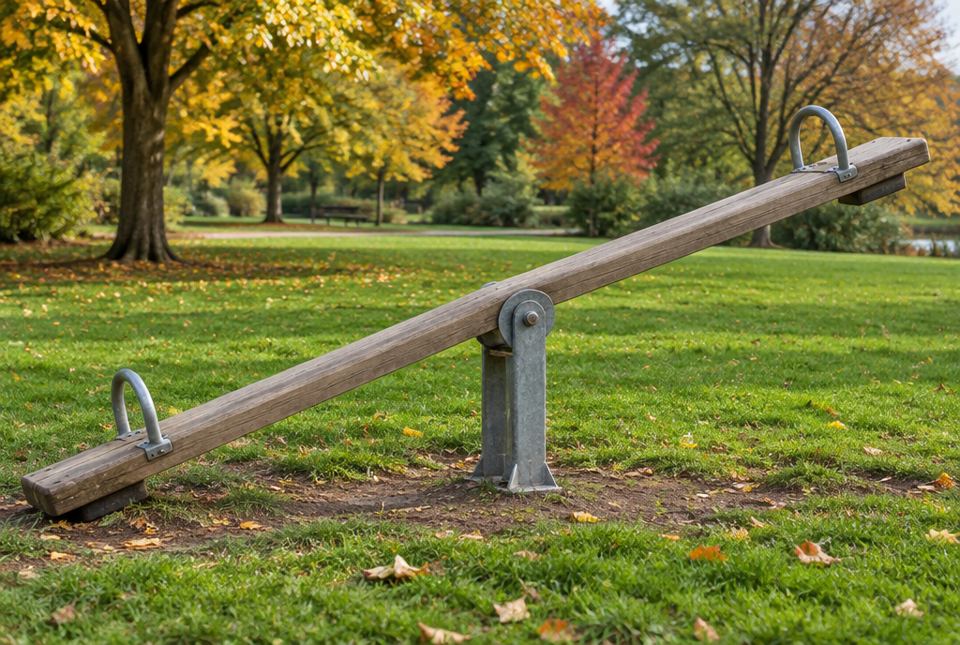 A seesaw is a lever. The long board is the bar, and the metal post in the middle is the fulcrum it turns on. AI-generated image
Parts of a lever
A lever is a stiff bar that turns on a point. It has four parts:
- the bar: the long, stiff part (a board, a stick, a handle),
- the fulcrum: the point the bar turns on,
- the load: the thing you want to lift or move,
- the effort: your push or pull.
You push down on one end. The bar turns on the fulcrum, and the load on the other end goes up.
Where should the fulcrum go?
Here is the big secret of levers:
When the fulcrum is close to the load, you need only a small push to lift it.
When the fulcrum is far from the load (and close to you), you need a big push.
That is why the heavy grown-up on the seesaw slides close to the middle (the fulcrum). Now the kid, far from the middle, can lift the grown-up.
| Lever | Fulcrum | Load | How it makes work easier |
|---|
| seesaw | the middle stand | the person on the other end | lets one person lift another |
| bottle opener | the edge resting on top of the cap | the cap | pops off a tight cap with a small lift |
| claw hammer | the head resting on the wood | the nail | pulls out a stuck nail |
| shovel prying up ice or dirt | the spot where the shovel rests on the ground | the ice or dirt | lifts a heavy chunk with less push |
| wheelbarrow | the wheel | the dirt or snow in the bucket | you lift a heavy load by the handles |
Worked exampleLet's find the parts of a lever
You use a big metal spoon to pry the lid off a paint can. Where are the bar, fulcrum, load and effort?
- Bar: the spoon handle.
- Fulcrum: the edge of the can, where the spoon rests and turns.
- Load: the stuck lid.
- Effort: your hand pushing down on the end of the spoon.
- The fulcrum (can edge) is very close to the load (lid), so a small push down pops the lid up.
Bar = spoon, fulcrum = can's edge, load = lid, effort = your push. It works because the fulcrum is close to the load.
Worked exampleLet's test it: where should the fulcrum go?
We put a juice box on one end of a wooden ruler, with a thick marker under the ruler as the fulcrum. We press down on the other end. Where is pressing easiest?
- Question: Does moving the fulcrum change how hard we have to press?
- Predict: I think it will be easiest when the marker is close to the juice box.
- Fair test: Keep the same ruler, the same juice box, and always press at the very end. Change only where the fulcrum is.
- Test 1: Marker in the middle of the ruler. Press. It takes a medium push.
- Test 2: Marker close to the juice box. Press. It is easy, but our hand had to move down farther.
- Test 3: Marker close to our hand. Press. It is hard, but the juice box goes up high.
Pressing was easiest when the fulcrum was close to the load. Our prediction was right!
Levers can trade
A lever with the fulcrum close to the load makes lifting easier, but you push your end farther. The load only goes up a little. Some levers do the opposite trade to move things farther and faster: a canoe paddle and a hockey stick are levers too.
Funny but trueLong ago, a Greek thinker named Archimedes is said to have joked: "Give me a lever long enough and a place to stand, and I will move the whole Earth!" Nobody has found a seesaw that big... yet.
Hands-on activityBuild a lever and feel the difference
You need: a sturdy wooden ruler or paint stir stick, a thick marker or a round pencil for the fulcrum, and a small load (a juice box, an apple or a small toy).
- Lay the marker on the table. Put the ruler across it.
- Put the load on one end of the ruler.
- Press down on the other end with one finger. Notice how hard you press.
- Move the marker closer to the load. Press again. Easier or harder?
- Move the marker close to your finger. Press again.
- Make a chart: where the fulcrum was, and "easy", "medium" or "hard".
- Tell a grown-up: Where should the fulcrum go to make lifting easiest?
Safety: Use a light load. Press gently so nothing flies off the ruler. Do not use a plastic ruler that could snap.
What to look for: fulcrum close to the load = easy; fulcrum close to your finger = hard.
Your turn
The point a lever turns on.
2Name the four parts of a lever.
The bar, the fulcrum, the load and the effort.
3On a seesaw, where is the fulcrum?
In the middle, where the seesaw rests on its stand.
4To lift a heavy rock with a long pole, should you put the fulcrum close to the rock or close to your hands?
Close to the rock (the load). Then a smaller push lifts it.
5Name a lever in your kitchen.
Answers will vary. Examples: a bottle opener, a can opener's handles, a nutcracker, a spoon prying a lid.
6You push down on one end of a seesaw. What happens to the other end?
7Why does a grown-up slide closer to the middle of a seesaw to balance with a child?
Close to the fulcrum, the grown-up's heavy weight has less turning power on the lever. Then the lighter child, far from the fulcrum, can balance or lift the grown-up.
More practice: warm-up
1Is a seesaw a lever or a pulley?
2What do we call the thing a lever lifts?
3What do we call your push on a lever?
4Does a lever turn on a point, or roll on wheels?
It turns on a point (the fulcrum).
5Is a bottle opener a lever?
More practice: on your own
1A claw hammer pulls a nail out of a board. Name the fulcrum, load and effort.
Fulcrum: where the hammer's head rests on the board. Load: the nail. Effort: your hand pulling the handle.
2You test a ruler lever. With the fulcrum close to the load, it is easy. With the fulcrum close to your finger, it is hard. What did you learn?
Levers lift most easily when the fulcrum is close to the load.
3In your lever test, why must you always press at the same spot on the ruler?
To keep the test fair. Only one thing (where the fulcrum is) should change.
4A wheelbarrow is a lever. Where is its fulcrum?
At the wheel. The bucket (load) is between the wheel and your hands.
5Why should you use a light load and press gently in the lever activity?
For safety. A heavy load or a hard push could make things fly off the ruler or break it.
Challenge
1Two kids sit on a seesaw. Ali is heavier than Ben. The seesaw tips down on Ali's side. Give two ways to balance it.
- Ali moves closer to the middle (the fulcrum). 2. Ben moves farther from the middle, out to the end. (Another way: a friend sits with Ben to add weight.)
2Your lever pushes the load up easily, but it only goes up a little. Why?
Levers make a trade. With the fulcrum close to the load, you push with less force, but your end has to move farther while the load moves only a little.
3A snow shovel is stuck under a heavy chunk of ice. Explain how to use it as a lever.
Slide the shovel blade under the ice. Rest the shovel on the ground or the edge of the step close to the ice: that is the fulcrum. Push down on the handle (effort). The ice (load) lifts up. A fulcrum close to the ice makes it easier.
Quiz
1. The point a lever turns on is the...
3. Where should the fulcrum go to lift a heavy load with the smallest push?
4. On a bottle opener, the load is...
5. When you push down on one end of a lever, the other end...
6. In a fair lever test, what should you change?
Big idea: A lever is a stiff bar that turns on a fulcrum. Levers are used every day to make lifting easier (D2.3, D2.4). Comparing how hard you press with the fulcrum in different places is a qualitative force comparison (D2.5), done as a fair test (A1.2) with safety rules (A1.4).
How to help: Visit a seesaw and experiment with where each person sits. At home, point out levers: bottle openers, nutcrackers, claw hammers, a spoon prying a lid. Ask, "Where is the fulcrum?"
Common difficulties:
- Thinking the fulcrum is always in the middle. On a seesaw it is, but on a bottle opener or hammer it is near one end.
- Expecting "something for nothing". An easier push means your end moves farther. That is the trade.
- Changing two things in the test (moving the fulcrum and pressing in a new spot). Ask, "What did we keep the same?"