A. Literacy Connections and Applications / C. Comprehension: Understanding and Responding to Texts · Understanding and Responding to TextsWho Is Telling? Point of View and Perspectives
C1.6 C3.5 A3.2About 40 minutes
Learning goals- I can tell if a story is told in first person or third person.
- I can retell part of a story from a different character's point of view.
- I can find a perspective in a text and the evidence for it.
- I can explain how a text might change what readers think or do.
Words to know
narrator
The voice that tells the story.
point of view
Who is telling the story and how much they know.
first person
The narrator is a character in the story and uses I, me, my and we.
third person
The narrator is outside the story and uses names and he, she, they.
perspective
How someone thinks or feels about something. Different people can have different perspectives on the same thing.
explicit
Said clearly in the words.
implicit
Not said directly, but shown through word choice and clues.
Remember from Grade 1
In Grade 1 you asked, "Who is telling this story?" This year you will learn the names for two kinds of narrators: first person and third person. You will also learn that people can see the same thing in very different ways.
| First person | Third person |
|---|
| Who tells it? | A character in the story | A narrator outside the story |
| Clue words | I, me, my, we, our | names, he, she, they, his, her |
| Example | I zoomed down the hill on my sled. | Kiara zoomed down the hill on her sled. |
Read-aloud 1: The Big Hill
I stood at the top of the big hill. My knees were shaking. My cousin Raj was already at the bottom, waving.
"You can do it, Kiara!" he yelled.
I sat on my red sled and held the rope. One... two... three... WHOOSH! I zoomed down so fast that the wind made my eyes water. I bumped over a lump of snow and flew off at the bottom.
I lay in the snow, laughing. "Again!" I shouted.
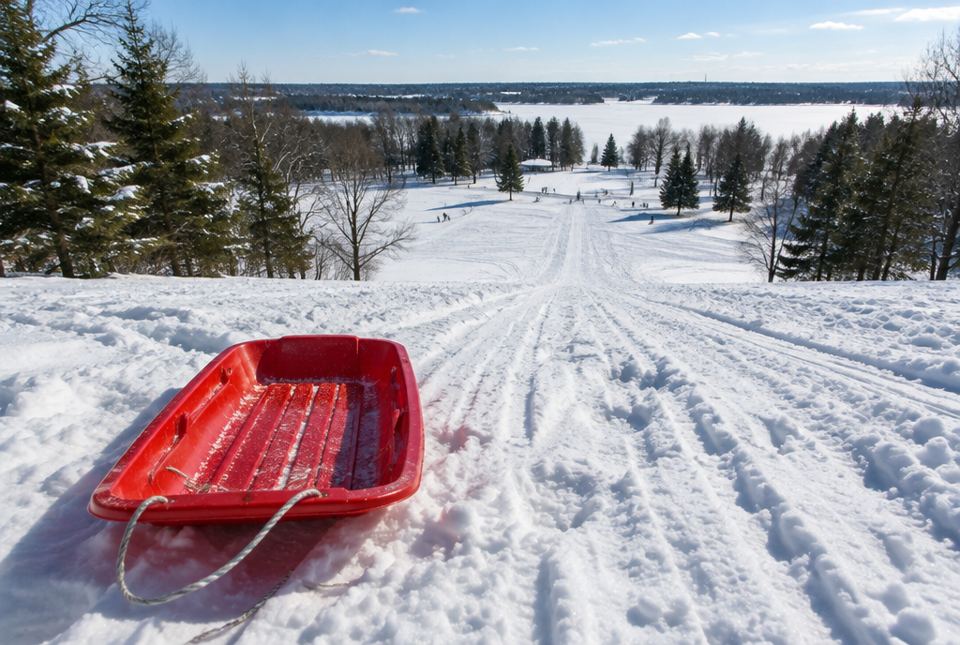 The view from the top of the big hill. How might Kiara feel looking down? How might Raj feel at the bottom? AI-generated image
Worked exampleLet's name the point of view
Who is telling The Big Hill? Is it first person or third person?
- Look for clue words: I stood, My knees, I sat on my red sled.
- The narrator says I and my. The narrator is a character in the story.
- Who is I? Raj yells, "You can do it, Kiara!" So the narrator is Kiara.
- Because Kiara tells her own story using I, it is first person.
- First person lets us know Kiara's inside feelings: her knees were shaking (scared at first), then she was laughing (happy).
The Big Hill is told in first person by Kiara.
In first person, the character tells her own story with I. In third person, a narrator outside the story tells it with a name or she.Worked exampleLet's change the point of view
Retell the start of The Big Hill in third person, and then from Raj's point of view in first person.
- Third person: change I to Kiara or she, and my to her. "Kiara stood at the top of the big hill. Her knees were shaking. Her cousin Raj was already at the bottom, waving."
- Raj's point of view (first person): Now I means Raj. Think: what would Raj see and feel? He is at the bottom, looking up.
- "I waited at the bottom of the hill. My cousin Kiara looked tiny up at the top. I could tell she was scared. 'You can do it, Kiara!' I yelled. Then WHOOSH! She flew down and tumbled into the snow, laughing. I was so proud of her."
- Notice: in Raj's version we learn new things, like that he felt proud. Each point of view shows different thoughts.
Changing the point of view changes whose thoughts and feelings we hear.
Perspectives: same snow, different feelings
A perspective is how someone thinks or feels about something. Read these two short texts about the same snowstorm.
Text A: Snow Day! by Zoe, age 7
Thirty centimetres of fluffy, sparkly snow! No school! I made the biggest fort on our street. Snow is the best thing ever.
Text B: Shovelling Again by Mr. Okafor, a neighbour
Thirty centimetres of heavy, wet snow fell last night. I shovelled for two hours, and my back is sore. The buses were cancelled, and the roads were slippery.
Worked exampleLet's find perspectives and evidence
What is Zoe's perspective on the snow? What is Mr. Okafor's? What evidence shows it?
- Zoe says Snow is the best thing ever. That perspective is explicit: she says it clearly.
- Mr. Okafor never says I don't like snow. But look at his word choice: heavy, wet, my back is sore, slippery. Those words show the snow made his day hard. His perspective is implicit: shown, not said.
- Compare word choice: Zoe calls the snow fluffy, sparkly; Mr. Okafor calls the same snow heavy, wet.
- Why different? Zoe gets to play and has no school. Mr. Okafor has to shovel and travel.
Zoe loves the snow (explicit). Mr. Okafor finds it hard work (implicit, shown by heavy, wet, sore, slippery). Same snow, two perspectives.
Texts can influence us
A text's perspective can influence (change) what the audience thinks or does.
If you only read Zoe's text, you might think everyone loves a snowstorm. If you only read Mr. Okafor's, you might think snow is terrible. Reading both helps you see the whole picture.
Some texts want to change your mind. Read this letter:
Dear Mayor,
Our neighbourhood needs an outdoor skating rink in Maple Park. Kids have nowhere to skate. Skating keeps people healthy and helps neighbours meet each other. Please build a rink this winter!
From, the students of Room 4
The students' perspective is explicit: they want a rink. They give reasons (health, meeting neighbours) to influence the mayor.
Ask: Whose voice is missing?
When you read about a topic, ask: Whose perspective is this? Who might feel differently? Whose voice is missing? For the rink letter, you might wonder what the people who look after the park, or neighbours who live beside it, would say.
Just for funTry a new point of view: "Everyone says it's the best snow day ever. But I'm the snowman, and I'm keeping one eye on the sun!"
Hands-on activitySame event, two voices
You need: paper and a pencil, and a family member to interview.
- Pick something that happened at home this week (a rainy day, a new pet, a family dinner).
- Write or say 2 sentences about it from your point of view in first person (I...).
- Interview a family member: "How did you feel about it?" Write 2 sentences from their perspective.
- Compare: Were your perspectives the same or different? Why?
- Bonus: retell a favourite fairy tale from the villain's point of view in first person! ("I am the wolf. I was just hungry...")
Your turn
1Is this first or third person? "We packed the car and drove to the cottage."
First person. The narrator uses we.
2Is this first or third person? "Sam packed his bag and ran to the bus."
Third person. It uses a name (Sam) and his.
3Who is the narrator of The Big Hill?
4How did Kiara feel at the start? How do you know?
Scared or nervous. Her knees were shaking.
5What is Zoe's perspective on the snowstorm?
She loves it: Snow is the best thing ever.
6Which words show Mr. Okafor's perspective?
heavy, wet, shovelled for two hours, my back is sore, slippery. They show the snow made his day hard.
7What do the students of Room 4 want?
An outdoor skating rink in Maple Park.
More practice: warm-up
1Name two first-person clue words.
Any two: I, me, my, we, our.
2Name two third-person clue words.
Any two: he, she, they, his, her, or a character's name.
The voice that tells the story.
5What does perspective mean?
How someone thinks or feels about something.
More practice: on your own
1Change to third person: "I lost my mitten in the snow."
"He (or She, or a name like Leo) lost his (or her) mitten in the snow."
2Change to first person: "Ava fed her cat and gave it a hug."
"I fed my cat and gave it a hug."
3Is Mr. Okafor's perspective explicit or implicit? Explain.
Implicit. He never says I don't like snow, but his words (heavy, sore, slippery) show it was hard for him.
4What reasons do the students give the mayor?
Kids have nowhere to skate; skating keeps people healthy; it helps neighbours meet each other.
5Why is it a good idea to read both Zoe's and Mr. Okafor's texts?
So you see more than one perspective and understand the whole picture: snow can be fun and hard work.
Challenge
1Retell The Big Hill from the sled's point of view in first person (2 or 3 sentences).
Example: "I am a red sled. Kiara sat on me and held my rope tight. WHOOSH! We zoomed down, I hit a bump, and she flew off. I hope she rides me again!" It must use I as the sled.
2Write a short reply to the mayor's letter from the perspective of a neighbour who lives beside Maple Park and is worried about the rink.
Example: "Dear Mayor, I live beside Maple Park. A rink might be noisy at night and need lots of care. Could it close at 8 p.m.?" It should show a different perspective with a reason.
3How might the letter to the mayor influence the mayor? What would make it even stronger?
It gives the mayor reasons to agree. It could be stronger with evidence, like how many kids want to skate, or a survey of neighbours, or a drawing of the rink plan.
Quiz
1. Which sentence is told in first person?
2. Which sentence is told in third person?
4. Which words show Mr. Okafor's perspective on the snow?
5. A perspective that is shown through clues, not said directly, is...
6. Why did the students of Room 4 give reasons in their letter?
Big idea: Children identify the narrator's point of view (first or third person) and suggest an alternative point of view (C1.6). They find explicit and implicit perspectives with evidence and think about how a text can influence an audience (C3.5). Considering many perspectives also supports A3.2 (identity and perspectives of diverse people).
How to help at home:
- While reading, ask: "Who is telling this story? How do you know?"
- Retell familiar stories from another character's view (The Three Bears from Baby Bear's view).
- When you see a news headline, ad or letter, ask: "What does the writer want us to think? Who might disagree?"
Common difficulties:
- Thinking any story with dialogue ("I want cake," said Tom) is first person. Dialogue inside quotation marks doesn't count; look at the narrator's words outside the quotes.
- Implicit perspectives. Focus on word choice: "Would someone who loves snow call it heavy and wet, and talk about a sore back?"